
Ecommerce is the buying and selling of products or services over the internet, where the order, the payment and most of the customer communication happen online. An online store is simply the software and the operation behind it: a website or app that shows products, takes payment securely, tells your team what to ship, and hands the parcel to a courier.
That definition fits in one sentence. Running a store that actually makes money does not. This guide walks through what happens behind the screen when someone clicks “Buy”, the parts every e-store needs, the main ecommerce business models, what the costs look like for a UAE seller, and the mistakes that sink most new stores in their first year.
What Is Ecommerce? A Plain-English Definition
Ecommerce (also written e-commerce or e commerce) covers any transaction where a customer places an order through a digital channel. The product can be physical, like shoes or perfume, digital, like software or an online course, or a service, like a cleaning booking or a consultation.
You will also hear the term digital commerce. It is slightly wider: it includes the full digital journey, such as product discovery on social media, personalized offers and customer accounts, not only the moment of payment. In day-to-day business conversations the two terms are used almost interchangeably.
What ecommerce is not: a business that only posts products on Instagram and closes every sale by phone is doing online marketing, not e-commerce. The test is whether the customer can complete the purchase digitally without waiting for a person to step in.
How big is ecommerce in 2026?
Large enough that it is no longer a side channel. Shopify, citing eMarketer forecasts, puts global retail ecommerce sales at around USD 6.88 trillion in 2026, roughly 21% of all retail sales worldwide. Closer to home, a report by EZDubai, reported by WAM, estimated the UAE ecommerce market at AED 42.2 billion in 2025, with a forecast of around AED 67.2 billion by 2030.
Different research firms measure different things (some include B2B, travel or digital services), so you will see wildly different figures online. The direction is consistent, though: more and more retail is moving online every year.
Where Ecommerce Happens: The Main Sales Channels
An online shopfront is not always your own website. Most businesses sell through one or more of these channels, and each one changes who controls the customer relationship.
| Channel | Example | Who owns the customer data | Main trade-off |
|---|---|---|---|
| Your own e-store | A WooCommerce or Shopify website | You | Full control and better margins, but you must bring your own traffic. |
| Marketplace | Amazon.ae, Noon | Mostly the marketplace | Instant audience, but commission fees and price competition |
| Social commerce | Instagram Shopping, TikTok Shop | Shared with the platform | Great for discovery, weaker for repeat buying |
| Mobile app | A branded shopping app | You | Excellent for loyal repeat customers, expensive to build for a new brand |
| Chat commerce | WhatsApp catalog with payment links | You | Personal and popular in the UAE, but hard to scale without automation |
A sensible pattern for a new brand is to use one channel for reach (a marketplace or social) and one owned channel for margin and repeat customers (your own website). Relying only on a marketplace means your sales can disappear with one policy change you have no say in.
How Does an Online Store Work? Following One Order From Click to Doorstep
The easiest way to understand an e-store is to follow a single order. Imagine a Dubai fragrance brand selling a AED 249 bottle of oud to a customer in Abu Dhabi.
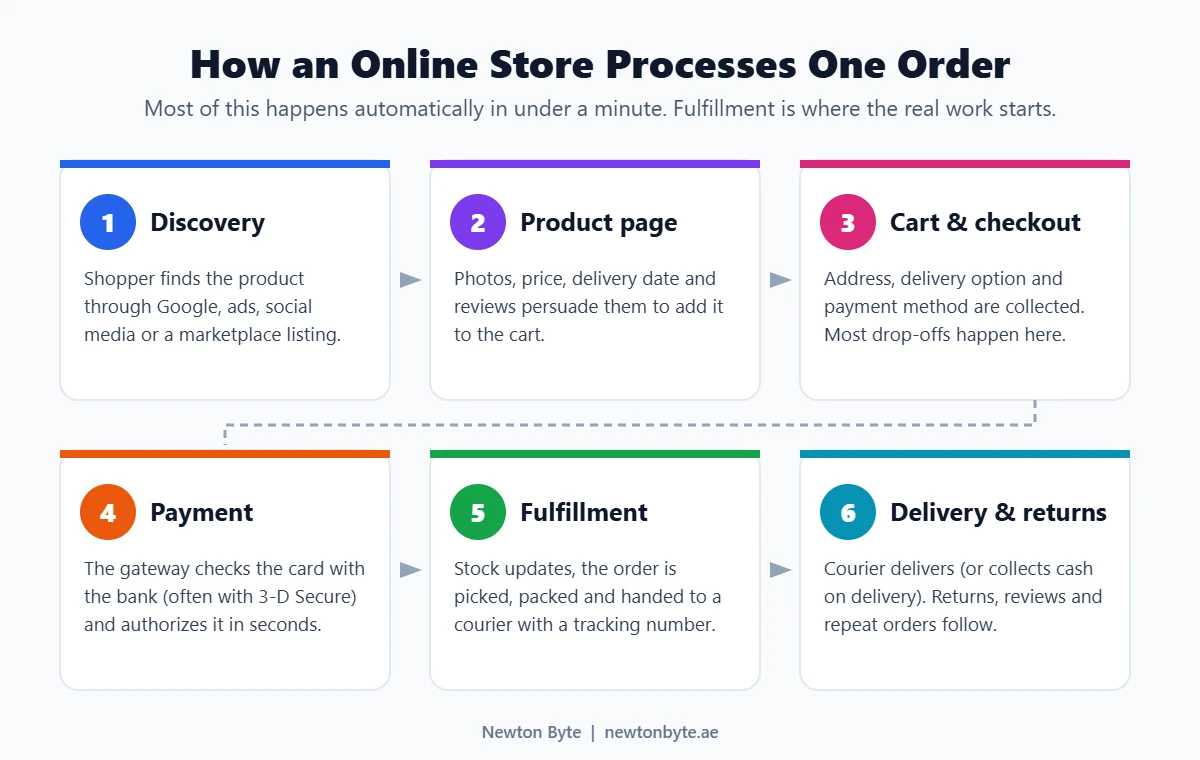
1. Discovery: the customer finds the product.
She searches “oud perfume gift” on Google, sees a shopping ad, and clicks. Other customers arrive from Instagram, a newsletter, or a friend’s link. This step has nothing to do with your website software and everything to do with marketing. A beautiful store with no traffic sells nothing.
2. The product page does the selling.
No sales assistant is standing next to her, so the page has to answer every question a good salesperson would: what does it smell like, how big is the bottle, when will it arrive, can I return it, what do other buyers say? Clear photos, an honest description, the delivery date and the total price, including delivery, matter far more than design flourishes.
3. Cart and checkout
She adds the bottle to the cart and enters her address, delivery option and payment method. This is where most online sales are lost. The Baymard Institute, averaging 50 separate studies, puts the typical cart abandonment rate at just over 70%. Some of that is window shopping, but a large share comes from surprise costs, forced account creation and long, confusing forms.
4. Payment authorization
When she taps “Pay”, the store sends the card details to a payment gateway (for example, Stripe, Checkout.com, Telr or Network International). The gateway passes the request through the card network to her bank, which may ask her to confirm with a one-time password (3-D Secure). The bank approves or declines in a few seconds.
One detail many new sellers miss: approval is not the same as having the money. Funds are settled to your bank account later, usually after a few working days, minus the gateway’s fee. Plan your cash flow around that delay.
5. Order management and fulfillment
The moment payment is approved, several things happen automatically: stock drops by one, she receives a confirmation email or WhatsApp message, and the order appears in your dashboard. Then the physical work starts. Someone picks the bottle from the shelf, packs it safely, prints a shipping label and books a courier. Growing stores often hand this step to a fulfillment center (a third-party logistics or 3PL company) that stores the stock and ships on their behalf.
6. Delivery, returns and after-sales
The courier delivers the parcel and, if she chose cash on delivery, collects the payment and later remits it to you. After delivery, the store sends a review request, handles any return, and, if everything went well, earns a second order. Repeat customers are where most ecommerce profit lives, because you do not pay to acquire them again.
The Building Blocks of an E-Store
Every online store, from a single-product brand to a large retailer, is made of the same core components. What changes is how sophisticated each one is.
| Component | What it does | Common options | What usually goes wrong |
|---|---|---|---|
| Ecommerce platform | Runs the catalog, cart, checkout and orders | Shopify, WooCommerce, Magento (Adobe Commerce), custom build | Choosing on price alone, then outgrowing it |
| Domain and hosting | Your web address and the servers the store runs on | .ae or .com domain, managed or cloud hosting | Cheap shared hosting that slows down during sales |
| Shopfront (theme) | The design customers see on desktop and mobile | Ready-made theme or custom design | Designing for desktop when most visitors use phones |
| Product catalog and inventory | Product data, variants, prices and stock levels | Built-in tools, POS or ERP integration | Online and shop stock are out of sync, leading to overselling |
| Payment gateway | Accepts cards, Apple Pay, Google Pay and instalments | Stripe, Checkout.com, Telr, Tabby, Tamara | Too few payment options at checkout |
| Shipping and fulfillment | Gets orders to customers and handles returns | Aramex, local couriers, 3PL warehouses | Underestimating per-parcel costs and failed COD deliveries |
| Marketing and analytics | Brings traffic and measures what works | SEO, Google Ads, Meta Ads, email, GA4 | No conversion tracking, so budget decisions are guesses |
| Customer service | Answers questions before and after purchase | WhatsApp, live chat, email, help center | Slow replies that kill purchases on high-value items |
Ecommerce Business Models Explained
“Ecommerce” describes how you sell. The business model describes who you sell to and how you make money. Picking the wrong model is a more expensive mistake than picking the wrong platform.
B2C (business to consumer)
A brand or retailer sells directly to individual shoppers. This is what most people picture when they hear ecommerce: fashion, electronics, beauty, and groceries. It has short sales cycles and high marketing costs because you are constantly winning new customers.
B2B (business to business)
Suppliers sell to other businesses: a wholesaler selling cleaning supplies to hotels or a distributor selling spare parts to garages. Orders are larger, buyers expect account pricing, bulk ordering and invoice payment terms, and the same customer reorders for years. By most estimates, B2B ecommerce is several times larger than consumer ecommerce worldwide, even though it gets far less attention.
D2C (direct to consumer)
A manufacturer or brand skips retailers and sells straight to the end customer through its own e-store. You keep the retail margin and own the customer data, but you take on all the marketing, customer service and logistics that a retailer used to handle.
C2C and marketplaces
A platform connects buyers and sellers and earns a commission, listing fee or advertising revenue, as with Dubizzle or eBay. Building a marketplace is hard because you need enough sellers and buyers at the same time before either side finds it useful.
Dropshipping
You sell products that a supplier ships directly to the customer, so you never hold stock. It is cheap to start, but margins are thin, delivery times are harder to control, and your brand takes the blame for the supplier’s mistakes. It works best as a way to test demand, not as a long-term brand.
Subscription
Customers pay on a schedule for repeat deliveries (coffee, pet food, skincare) or ongoing access (software, memberships). Predictable revenue is the big advantage; the risk is churn, so the product has to earn its renewal every month.
Digital products and services
Courses, templates, software licences and bookable services. There is no shipping and almost no cost per extra sale, but piracy, refunds and support become the main operational concerns.
| Model | Inventory risk | Margin potential | Hardest part |
|---|---|---|---|
| B2C retail | High | Medium | Customer acquisition cost |
| B2B | Medium to high | Medium | Pricing rules, approvals and integrations |
| D2C | High | High | Building a brand people search for |
| Marketplace | None to low | Low per order, high at scale | Attracting both buyers and sellers |
| Dropshipping | None | Low | Quality and delivery control |
| Subscription | Medium | High over time | Keeping customers subscribed |
| Digital products | None | Very high | Standing out and preventing refunds |
Choosing an Ecommerce Platform: Hosted, Self-Hosted or Custom
There is no single “best” platform. There is a best fit for your catalog size, budget and growth plans.
- Hosted platforms (such as Shopify) handle hosting, security and updates for a monthly fee. They are the fastest route to launch and suit brands that want to focus on products and marketing. You pay ongoing subscription and app fees, and deep customization can be limited.
- Self-hosted open source (such as WooCommerce) runs on WordPress and gives you full control over design, data and integrations with no platform transaction fees. You are responsible for hosting, updates and security, so it suits businesses with a technical partner. See our WooCommerce development service for what a professional build involves.
- Enterprise platforms (such as Magento / Adobe Commerce) handle very large catalogs, multiple stores and complex B2B rules, at a matching development cost.
- Custom builds make sense when your process does not fit standard software, for example complex product configurators, unusual pricing logic or deep ERP integration. Our custom ecommerce work usually starts with mapping exactly where off-the-shelf tools fall short.
A practical rule: if you sell fewer than a few hundred products and your checkout is standard, start on a mainstream platform. Move to something more complex only when you can name the specific limitation that is costing you sales.
What It Really Costs to Run an Online Store in the UAE
Most “how much does a website cost” articles stop at the build price. The build is usually the smallest part of the bill over the first year. These are the costs that actually decide whether an order is profitable:
- Platform and apps: monthly subscription, paid plugins or apps, and hosting.
- Payment processing: card gateways typically charge a percentage of each transaction plus a small fixed fee, and international cards usually cost more than local ones. Always check the provider’s current published pricing.
- VAT: the UAE standard rate is 5%. If your prices include VAT, part of every sale belongs to the Federal Tax Authority, not to you.
- Shipping and packaging: per-parcel courier fees, packaging, and the extra cost of failed or refused cash-on-delivery orders.
- Marketing: the ad spend required to win each new customer, often the highest variable cost.
- Returns: reverse shipping, damaged stock and staff time.
A worked example: Is a AED 249 order profitable?
Here is how the oud order from earlier might break down. These are illustrative assumptions, not benchmarks, so replace them with your own numbers.
| Line item | Amount (AED) |
|---|---|
| Price paid by customer (VAT inclusive) | 249.00 |
| Less VAT at 5% (249 ÷ 1.05) | −11.86 |
| Net revenue | 237.14 |
| Product cost | −90.00 |
| Payment fee (assumed 3% of 249) | −7.47 |
| Delivery (assumed free to the customer) | −20.00 |
| Packaging | −5.00 |
| Advertising cost to win this customer | −45.00 |
| Contribution before overheads | 69.67 |
A healthy-looking AED 249 sale leaves under AED 70 to cover salaries, rent, software and returns. Double the ad cost per customer and most of that disappears. This is why experienced ecommerce operators obsess over three numbers: conversion rate, average order value and repeat purchase rate.
The Numbers That Decide Whether an E-Store Works
Online store revenue comes down to a simple formula:
Revenue = visitors × conversion rate × average order value
If 10,000 people visit in a month, 2% buy, and the average order is AED 250, the store takes AED 50,000. Raise the conversion rate to 2.5% with a better checkout, and revenue rises to AED 62,500 with no extra ad spend. That is why improving the site you already have is often cheaper than buying more traffic.
- Conversion rate: the share of visitors who buy. Most stores convert a low single-digit percentage of visitors; it varies widely by product, price and traffic source.
- Average order value (AOV): raised with bundles, free-delivery thresholds and relevant add-ons.
- Customer acquisition cost (CAC): total marketing spend divided by new customers. If it is higher than the profit on a first order, you need repeat purchases to break even.
- Repeat purchase rate: the share of customers who come back. This is where ecommerce businesses become genuinely profitable.
None of these can be managed without accurate tracking. If you run ads, set up conversion tracking before you spend serious budget, not after.
Ecommerce in the UAE: What Is Different
The fundamentals are global, but selling online in the UAE has a few local realities worth planning for:
- Mobile first, really: most UAE shoppers browse and buy on their phones. Test every page, especially checkout, on a mid-range Android phone, not just a laptop.
- Payment preferences: cards, Apple Pay and buy-now-pay-later services such as Tabby and Tamara are widely used, and many customers still expect cash on delivery for first orders. COD increases conversions but also raises refused-delivery costs, so some stores limit it by order value or location.
- Delivery expectations: same-day and next-day delivery in Dubai and Abu Dhabi are common, so a five-day delivery promise looks weak by comparison.
- Bilingual audiences: English is usually enough to launch, but Arabic product content can open up a large audience, particularly for family and gifting categories.
- Licensing: you need a trade license that covers online selling. Mainland and free zone authorities both offer e-commerce activities, and Dubai has an eTrader license aimed at individuals and home-based sellers. Requirements change, so confirm with the relevant authority before launching.
- Search visibility: marketplaces dominate many product searches, so your own store needs a deliberate ecommerce SEO strategy to win organic traffic.
Common Mistakes New Online Stores Make
- Launching without a traffic plan. “Build it, and they will come” does not work online. Decide before launch where the first 1,000 visitors will come from and what it will cost.
- Hiding the delivery cost until checkout. Unexpected extra costs are one of the most common reasons people abandon carts. Show delivery fees or a free-delivery threshold on the product page.
- Forcing account creation. Offer guest checkout. You can invite customers to create an account after they have paid.
- Thin product pages. A one-line description copied from the supplier gives Google nothing to rank and customers nothing to trust. Write original descriptions that answer real questions.
- Ignoring page speed. Large uncompressed images and too many apps slow the store, especially on mobile data.
- Treating online and in-store stock separately. If you also sell in a shop, connect your POS system to the e-store so you do not sell items you no longer have.
- Measuring revenue instead of profit. High sales with a high ad cost per order can lose money. Track contribution per order, as in the worked example above.
Online Store Launch Checklist
- Trade license covers online selling, and VAT registration is sorted if you meet the threshold
- Business model and channels chosen (own site, marketplace, social or a mix)
- Platform selected based on catalog size, budget and integrations
- Payment gateway approved, with cards, Apple Pay and the methods your customers expect
- Courier contracts in place, with delivery times and COD rules decided
- Product pages with original descriptions, clear photos, prices including VAT and delivery information
- Returns, privacy, delivery and terms pages published
- Full test order completed on mobile, including a refund
- Analytics and conversion tracking installed and verified
- Launch marketing plan with a budget and a target cost per order
Frequently Asked Questions About Ecommerce
Is ecommerce the same as online shopping?
Online shopping is the customer’s side of ecommerce. Ecommerce is the wider system that includes the seller’s platform, payments, logistics, marketing and B2B trade between companies.
What is the difference between an e-store and an online storefront?
An online storefront usually means the customer-facing part of the store: the pages, products and checkout people see. An e-store includes everything behind it too, such as inventory, order management, payments and fulfillment.
How long does it take to build an online store?
A simple store on a hosted platform with a ready-made theme can launch in a few weeks once products, photos and payment approval are ready. A custom or heavily integrated store typically takes a few months. Product content and payment gateway approval are often the real bottlenecks, not the design.
Can I start ecommerce without holding stock?
Yes, through dropshipping, print on demand or selling digital products. The trade-off is lower margins and less control over quality and delivery.
Do I need a license to sell online in the UAE?
Yes. Online selling requires a trade license with an appropriate e-commerce activity, issued by a mainland authority or a free zone. Individuals in Dubai can look at the eTrader license. Rules and fees change, so check with the issuing authority for your emirate.
Is ecommerce still profitable in 2026?
It can be, but profit depends on margins, customer acquisition cost and repeat purchases rather than on simply being online. Stores with a clear niche, strong product pages and customers who come back tend to do well; stores that rely only on paid ads to sell low-margin products struggle.
Turning an Online Store Into a Real Business
Ecommerce is simple to describe and demanding to run well. The software handles the cart and the payment in seconds; the profit comes from everything around it: the right business model, honest product pages, a checkout without friction, reliable delivery and customers who come back.
If you are planning a new store or your current one is not converting, Newton Byte builds and grows online stores for UAE businesses, from platform selection and design to SEO and paid ads. Explore our ecommerce solutions or get in touch to talk through your plans.