
Magento ecommerce is the right choice when your store has outgrown simpler platforms: you manage thousands of products, run several stores or brands, sell to businesses with special pricing, or need deep integrations with systems like your ERP. It’s also a platform that needs experienced developers and strong hosting. If neither of those fits your situation yet, Shopify or WooCommerce will usually serve you better.
This guide helps you decide honestly. You’ll see the clear signs that point to Magento, what it really costs to run, what Magento hosting needs in 2026, and when you should wait.
What Is Magento Today?
Magento is an open-source ecommerce platform owned by Adobe. Magento ecommerce comes in two editions:
- Magento Open Source: free to download and use. You pay for development, hosting and extensions, but not for a licence.
- Adobe Commerce: the paid edition, priced by quote and aimed at large businesses. It adds built-in B2B features, advanced marketing tools and an optional cloud hosting service.
Magento isn’t the most popular platform by store count. Store Leads data reported by MGT Commerce puts it at around 111,000 active stores in early 2026, far behind Shopify and WooCommerce. But it’s concentrated at the top end. A 2026 study by Visionary Marketing found Magento runs about 8% of online stores overall, yet nearly 25% of stores have more than USD 635,000 in revenue. In other words, Magento ecommerce is mostly chosen by stores that have already grown.
The platform is also actively developed. Adobe released Magento 2.4.9 in May 2026, with more than 500 fixes and a modernized server stack.
6 Signs Magento Ecommerce Is the Right Choice
If two or three of these describe your business, Magento deserves a serious look.
1. You manage a large, complex product catalog
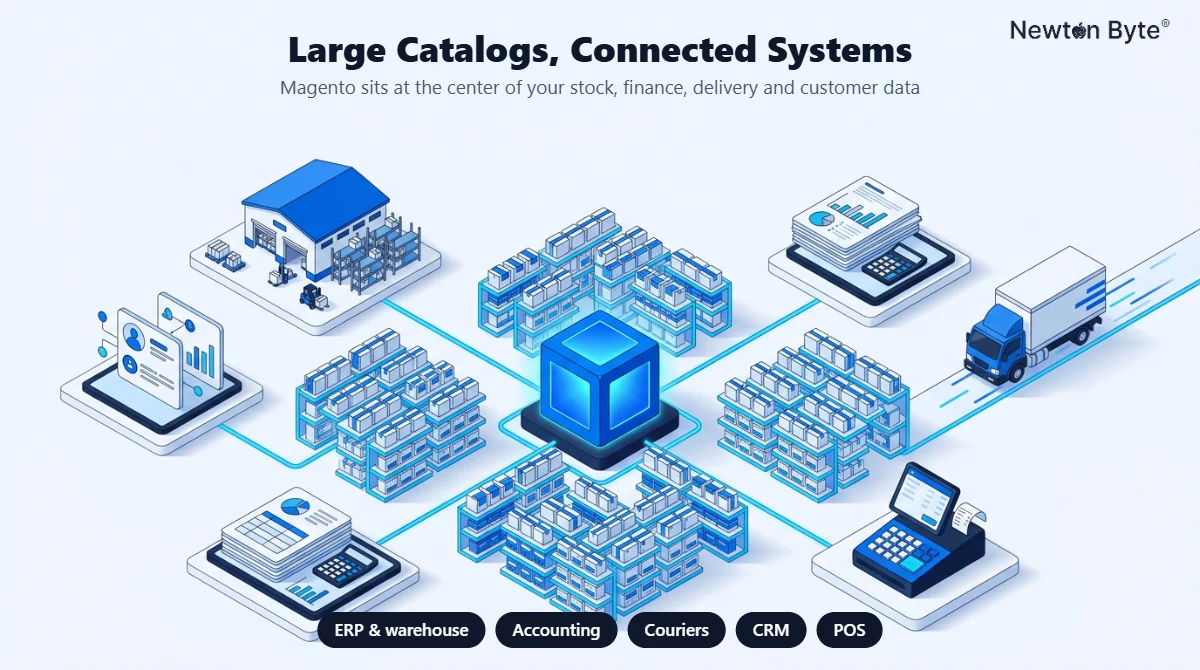
Magento e-commerce handles large product catalogs well, especially when products have many attributes and options. Think of an auto parts store where each part fits specific makes, models and years, or an electronics retailer with thousands of SKUs and detailed specifications. Magento’s attribute system, layered navigation and product types (configurable, bundled, grouped) were built for exactly this.
2. You run more than one store, brand or country
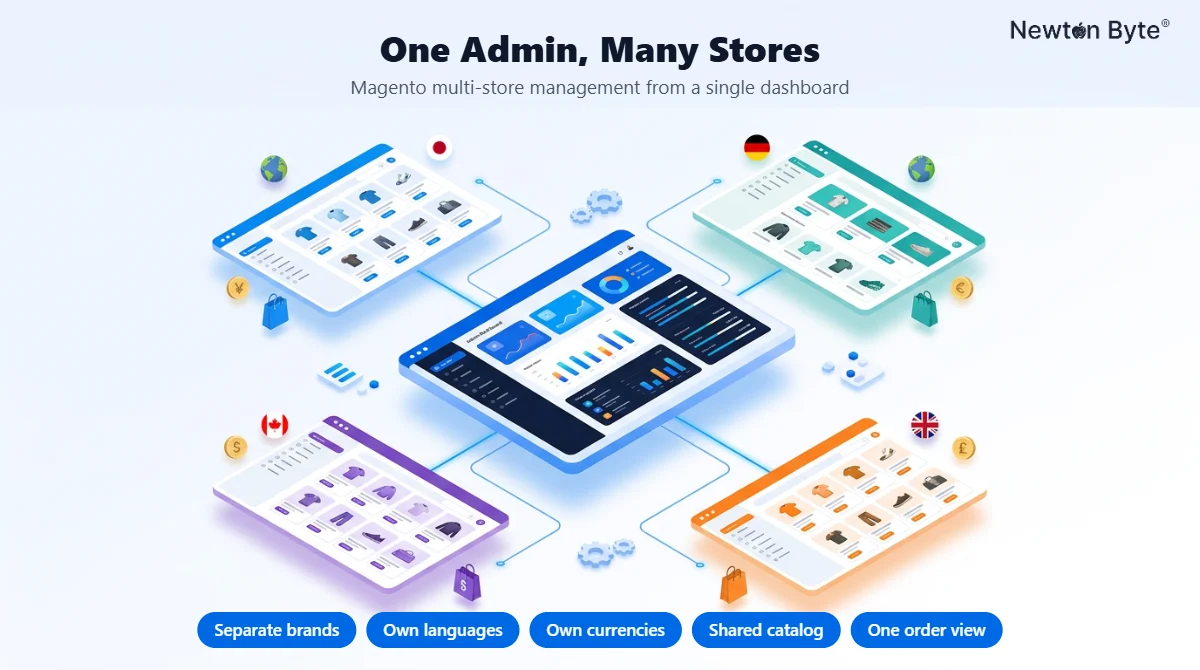
Multi-store management is where Magento ecommerce really stands out. From a single admin, you can run separate websites for different brands and separate store views for different languages, each with its own prices, currency and design. A UAE retailer could run an English and Arabic store for the UAE plus a separate site for Saudi Arabia, all sharing one catalog and one order system.
3. You sell to businesses as well as consumers
Wholesalers and distributors need things most platforms struggle with: different prices for different customer groups, quantity-based tier pricing, and bulk ordering. Magento Open Source supports customer group pricing and tier pricing out of the box. Full B2B tools like company accounts, quote requests and requisition lists are built into Adobe Commerce or can be added to open source with extensions.
4. You need custom integrations with your business systems
Growing stores rarely run on their store platform alone. Stock lives in an ERP or warehouse system, invoices in accounting software, deliveries with couriers, and customer history in a CRM. With Magento ecommerce, open code and strong APIs make it possible to build custom integrations that sync these systems properly, rather than relying on fragile workarounds.
5. You need business logic no app can provide
Maybe your pricing changes by region and customer type, your checkout needs special approval steps, or your products are made to order. Because you own the code, a Magento developer can build almost any rule your business needs without waiting for an app developer to add a feature.
6. You want full ownership of your platform and data
With Magento Open Source, nobody can change your platform rules, raise your subscription price or limit your access to data. You choose your hosting, your developers and your roadmap. For larger businesses, that control is often worth the extra responsibility.
When Magento Is Not the Right Choice (Yet)
Magento is powerful, but power has a cost. It’s probably not right for you if:
- You sell a few hundred products or fewer in one store and one market.
- You don’t have, and don’t plan to hire, an experienced Magento developer or agency.
- You need to launch in a few weeks on a tight budget.
- You’d rather never think about servers, updates or security patches.
In those cases, a simpler platform lets you focus on selling. Our guides on whether WooCommerce is right for your store and how to choose a Shopify partner cover those routes.
Magento vs Shopify vs WooCommerce at a Glance
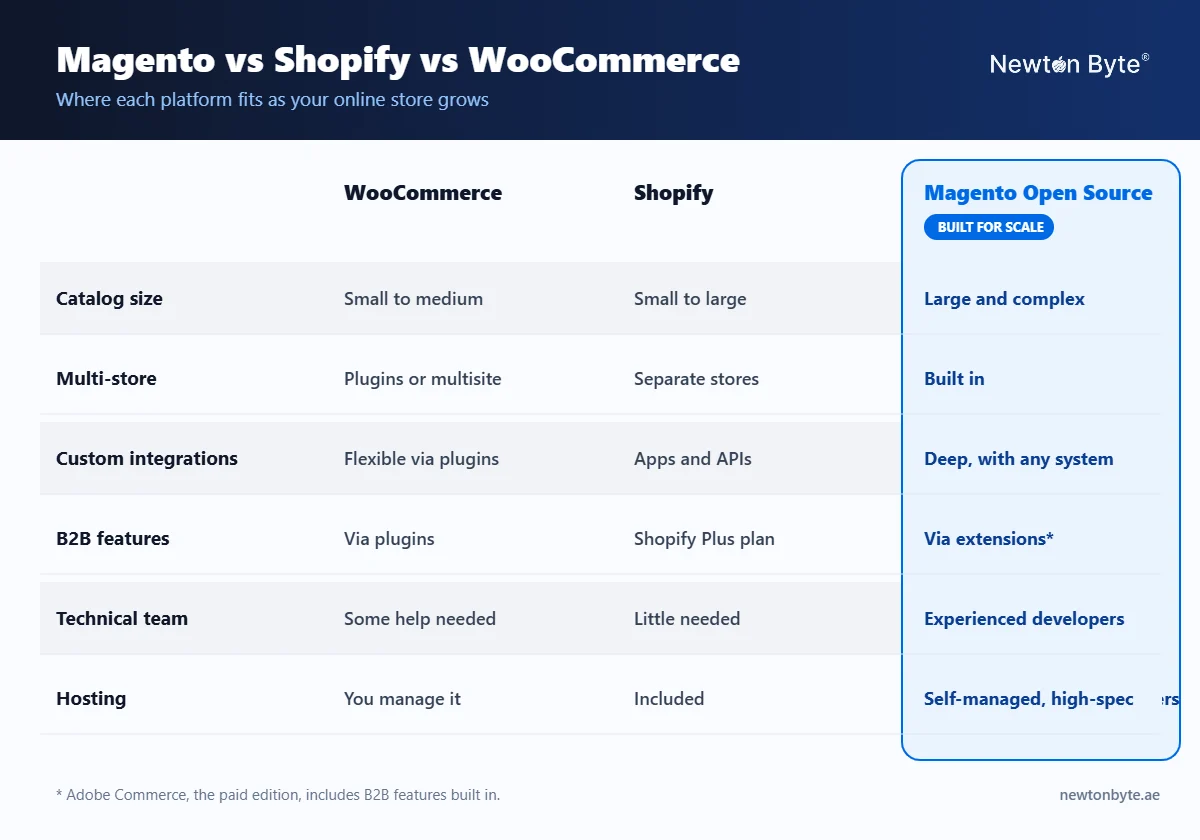
The short version: Shopify is the easiest to run, WooCommerce is the most flexible for content-led stores, and Magento ecommerce is built for scale and complexity. Many stores start on Shopify or WooCommerce and move to Magento only when their catalog, number of stores or integrations demand it.
What Magento Ecommerce Really Costs
Magento Open Source has no licence fee, but Magento e-commerce is rarely the cheapest option overall. Plan for these costs:
| Cost | What it covers | Why it matters |
|---|---|---|
| Development | Design, setup, custom features and integrations | Usually the highest upfront cost, as Magento projects need specialist developers |
| Extensions | Paid modules for payments, shipping, search or B2B | Quality varies, so choose well-supported vendors. |
| Hosting | Servers powerful enough for Magento | Cheap hosting is the fastest way to a slow store. |
| Upgrades and security patches | Keeping Magento and extensions up to date | Adobe releases regular security patches that need applying and testing. |
| Ongoing support | Fixes, monitoring and new features | Most Magento stores keep a developer or agency on retainer. |
One cost has dropped recently. Hyvä, the popular fast front-end theme for Magento, became free and open source in November 2025. It loads far less code than Magento’s default theme, so a fast shopfront is now much more affordable.
Magento Hosting: What Your Store Needs in 2026
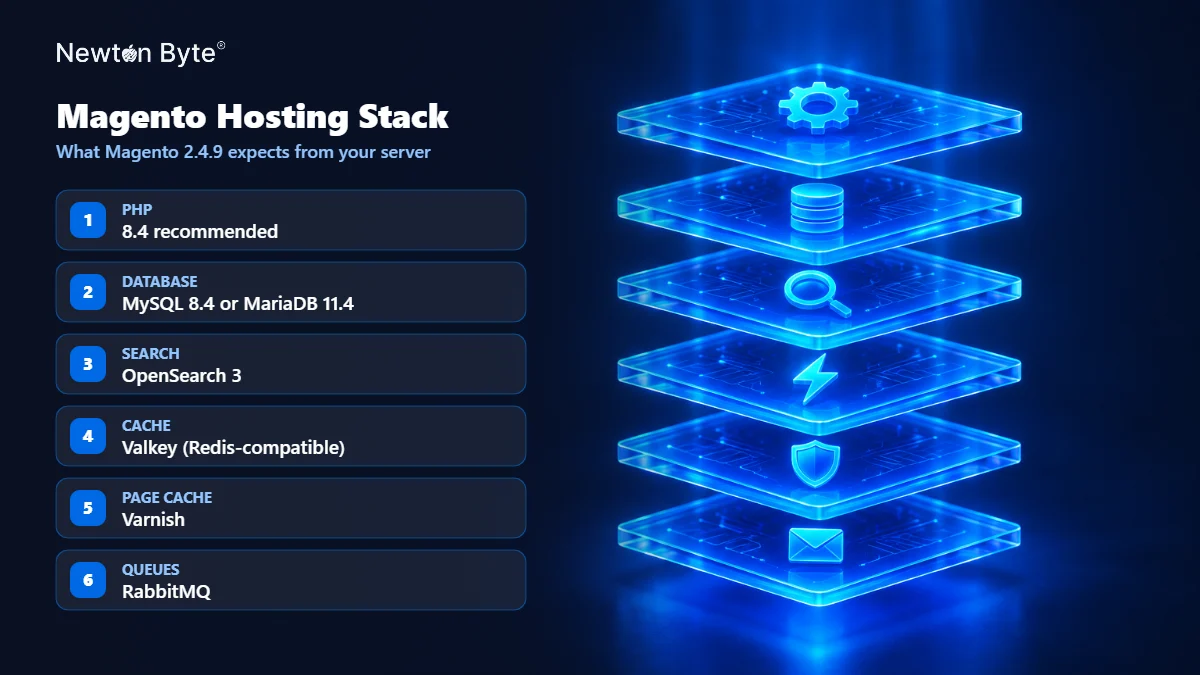
Magento e-commerce is a heavy application. Standard shared hosting won’t run it well. For Magento 2.4.9, your server needs a modern stack:
- PHP 8.4 (8.5 is also supported, and PHP 8.2 is no longer supported)
- MySQL 8.4 or MariaDB 11.4 for the database
- OpenSearch 3 for product search and filtering
- Valkey, an open-source Redis-compatible cache, which replaces Redis as the recommended option
- Varnish for full-page caching, which makes a big difference to speed
- RabbitMQ for background tasks like order processing and imports
Good Magento hosting also includes a staging environment, daily off-site backups, a web application firewall and someone who monitors the server. If you’re still on an older version, check your support status: according to i95Dev, support for Magento 2.4.5 and 2.4.6 ended in August 2026, so those stores no longer receive security fixes.
Our hosting and DevOps services set up and manage this stack, and our web hosting plans cover smaller sites.
A Simple Way to Decide
Answer these five questions honestly:
- Do you have, or expect soon, thousands of products with complex options?
- Do you need more than one store, brand, language or country?
- Do you sell to businesses with their own prices or bulk ordering?
- Do you need your store to sync with an ERP, warehouse or accounting system?
- Do you have the budget for experienced developers and proper hosting?
If you answered yes to question 5 and at least two of the others, Magento e-commerce is very likely a good fit. If question 5 is a no, start with a simpler platform and revisit Magento when you grow.
Frequently Asked Questions About Magento
Is Magento open source really free?
The software is free. You still pay for development, hosting, extensions and ongoing maintenance, which usually makes Magento more expensive to run than hosted platforms.
Is Magento good for SEO?
Yes. Magento ecommerce gives you control over URLs, metadata, canonical tags and site structure. Speed is the usual weak point, which a lightweight theme like Hyvä and proper hosting solve. Our ecommerce SEO guide for the UAE covers the rest.
Does Magento support Arabic?
Yes. You can create an Arabic store view alongside English with its own translations and settings. Your theme needs to support right-to-left layouts properly, which is worth confirming with your developer early.
How long does a Magento store take to build?
Much longer than a Shopify or WooCommerce store. A Magento build with custom design and integrations typically takes several months, depending on scope and how ready your product data is.
Can I move from Shopify or WooCommerce to Magento later?
Yes. Products, customers and orders can be migrated. The key is careful URL redirects to protect your rankings, as we explain in our guide to redesigning without losing SEO.
Is Magento Right for Your Growing Store?
Magento ecommerce shines when complexity is your main challenge: large catalogs, several stores, B2B selling and many connected systems. It rewards businesses that invest in good developers and solid hosting, and it frustrates those that don’t. Be honest about where you are today and where you’ll be in two years.
New to online selling? Start with what ecommerce is and how an online store works. If you’re weighing Magento for your business, Newton Byte offers Magento solutions for UAE businesses, from builds and integrations to hosting and ongoing support. Contact us for an honest assessment of whether Magento is the right move.