
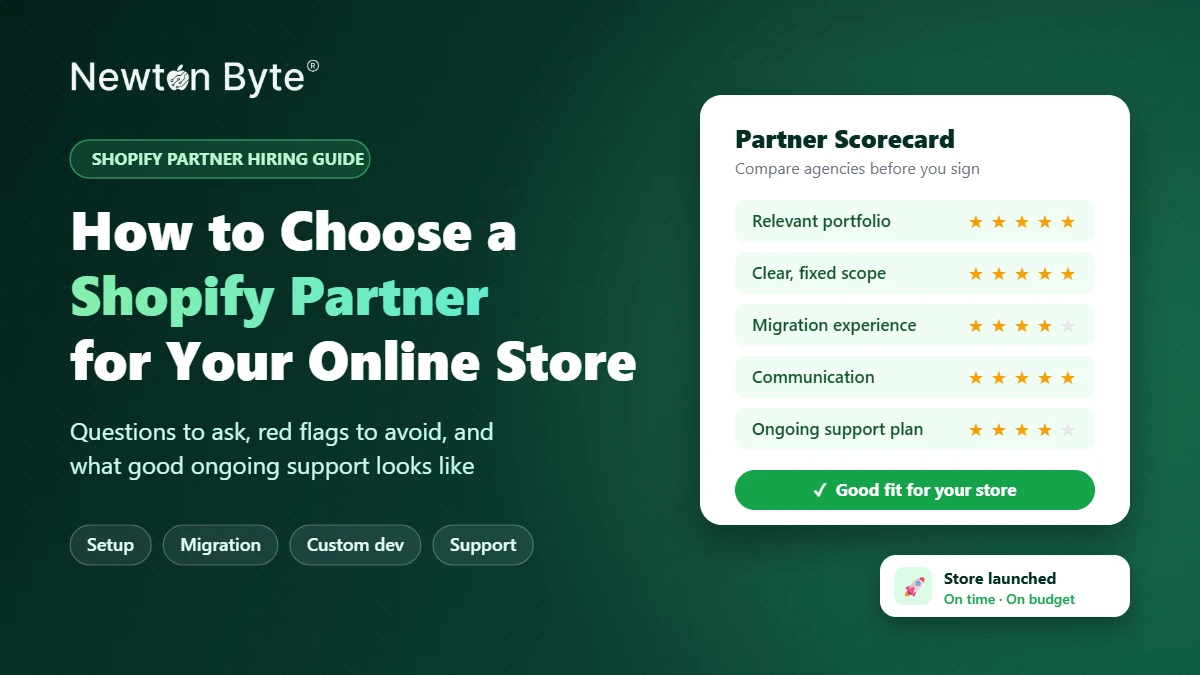
The right Shopify partner is the one with proven experience in stores like yours, a clear written scope, a safe way of accessing your store, and a real plan for support after launch. A badge, a low price or a beautiful portfolio on its own isn’t enough.
Choosing between Shopify partners can feel like guesswork, because most agencies say the same things on their websites. This guide shows you how to compare them properly: what partner tiers actually mean, what to prepare before you reach out, which questions reveal the most, and how to protect your store along the way.
What Shopify Partners Actually Do
Shopify partners are agencies, freelancers and developers who build, improve and look after Shopify stores for merchants. Shopify lists approved partners in its official Partner Directory, but they work independently, so you hire and pay them directly.
Most Shopify partners focus on five areas:
- Shopify store setup: launching a new store with a theme, products, payments, shipping and taxes.
- Design and theme customization: making the store look and feel like your brand.
- Custom Shopify development: features a theme or app that can’t be handled, such as custom product builders or integrations with your POS or ERP.
- Shopify migration: moving your store from WooCommerce, Magento or another platform without losing data or rankings.
- Ongoing store support: fixes, updates, speed work and new features after launch.
Some Shopify partners do all five. Others specialize. Knowing which of these you need is the first step to choosing well.
Understand Shopify Partner Tiers (But Don’t Overrate Them)
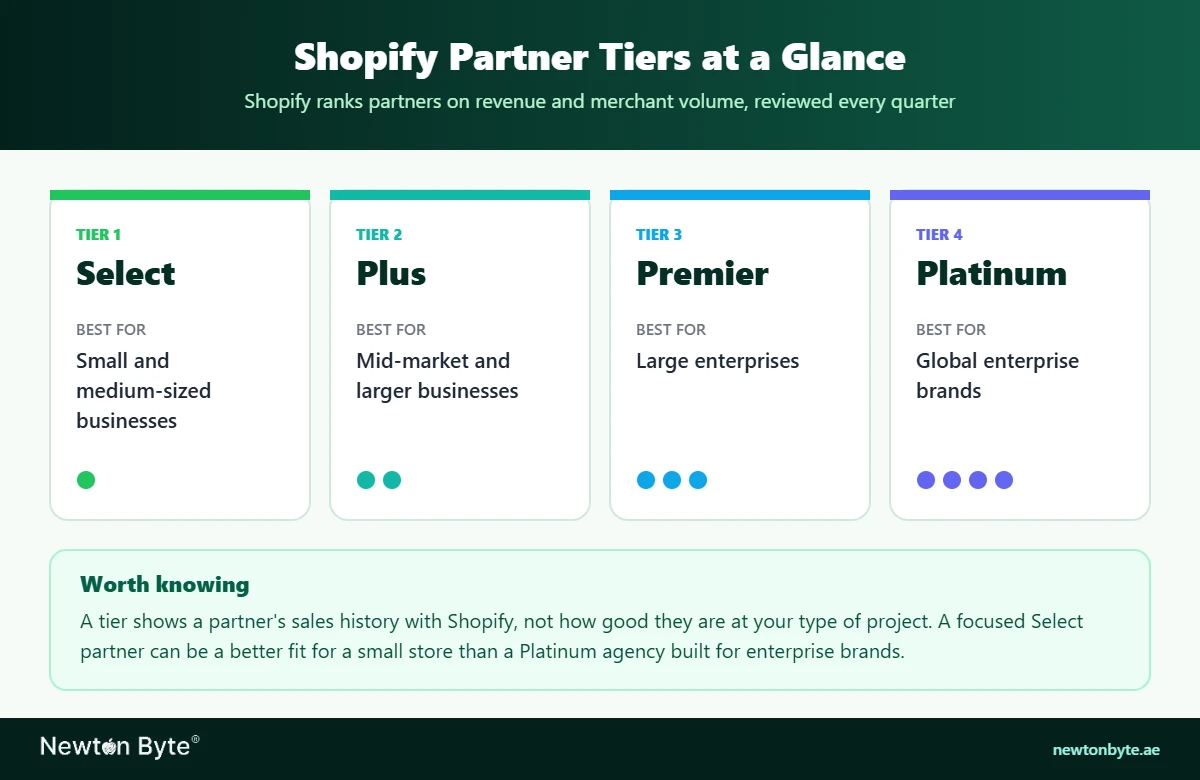
The Partner Directory groups Shopify partners into four tiers. According to Shopify’s help center, Select partners are best for small and medium-sized businesses, Plus partners for mid-market and larger businesses, Premier partners for large enterprises, and Platinum partners for global enterprise brands. There’s also an entry-level “Registered” status below these.
Tiers are based mainly on how much revenue a partner’s clients bring to Shopify and how many merchants they work with, and they’re reviewed every quarter. That tells you a partner is established. It doesn’t tell you whether they’re good at your kind of project.
A practical rule: match the tier to your size. A growing UAE fashion brand with a few hundred products will usually get more attention and a better price from a strong Select partner than from a Platinum agency whose typical client is a global enterprise.
Prepare a Short Brief Before You Contact Anyone
The best way to get honest, comparable quotes is to send every one of the Shopify partners on your shortlist the same one-page brief. It doesn’t need to be formal. Include:
- Your goal: a new store, a redesign, a migration, or help with an existing store.
- Your catalog: roughly how many products and variants you have.
- Must-have features: for example, Arabic and English, cash on delivery, product bundles, or wholesale pricing.
- Systems to connect: your POS, accounting software, courier, or ERP.
- Stores you like: two or three examples and what you like about each.
- Budget range and deadline: even a rough range saves everyone time.
- Who runs the store after launch: your team, the partner, or a mix.
Shopify partners who ask good follow-up questions about this brief are usually the ones who will plan your project properly.
How to Evaluate a Shopify Development Partner
Visit their live stores; don’t just look at screenshots
Open two or three stores they’ve built on your phone. How fast do they load? Is it easy to find a product, add it to the cart and reach checkout? Screenshots can hide slow pages and clumsy navigation. Live stores can’t.
Look for relevant experience
A partner who has built five fragrance stores understands product variants, gifting and sampling better than one who has only built tech stores. The same goes for B2B, large catalogs, or bilingual stores.
Check reviews in the right places
Reviews in the Partner Directory come from merchants who actually worked with the partner. Shopify only sends a review request 45 days after a merchant accepts the partner’s collaborator request, as explained in its guide to hiring partners. Combine these with Google reviews and, if possible, a quick call with a past client.
Meet the people who will do the work
The person who sells you the project is often not the person who builds it. Ask who your project manager and developer will be and whether the work is done in-house or outsourced.
Shopify Store Setup vs Custom Shopify Development
Quotes for “a Shopify store” can differ wildly because Shopify partners are often pricing different things. This table helps you compare like with like:
| Type of work | What it usually includes | Best for |
|---|---|---|
| Theme setup | A ready-made theme, your branding, products, payments and shipping | New stores that need to launch quickly |
| Theme customization | Changes to layouts, sections and styling on an existing theme | Brands that want a more unique look without a full rebuild |
| Custom Shopify development | Custom sections, features, apps or integrations built for you | Stores with needs that themes and apps can’t meet |
| Headless build | A fully custom front end connected to Shopify behind the scenes | Large brands with complex content and big budgets |
A useful habit: before paying for custom work, ask the partner whether an existing app could do the same job. Good partners will tell you when you don’t need custom code, even if it means a smaller invoice. If you need something truly bespoke, our custom ecommerce team can scope it with you.
Shopify Migration: Where Experience Really Shows
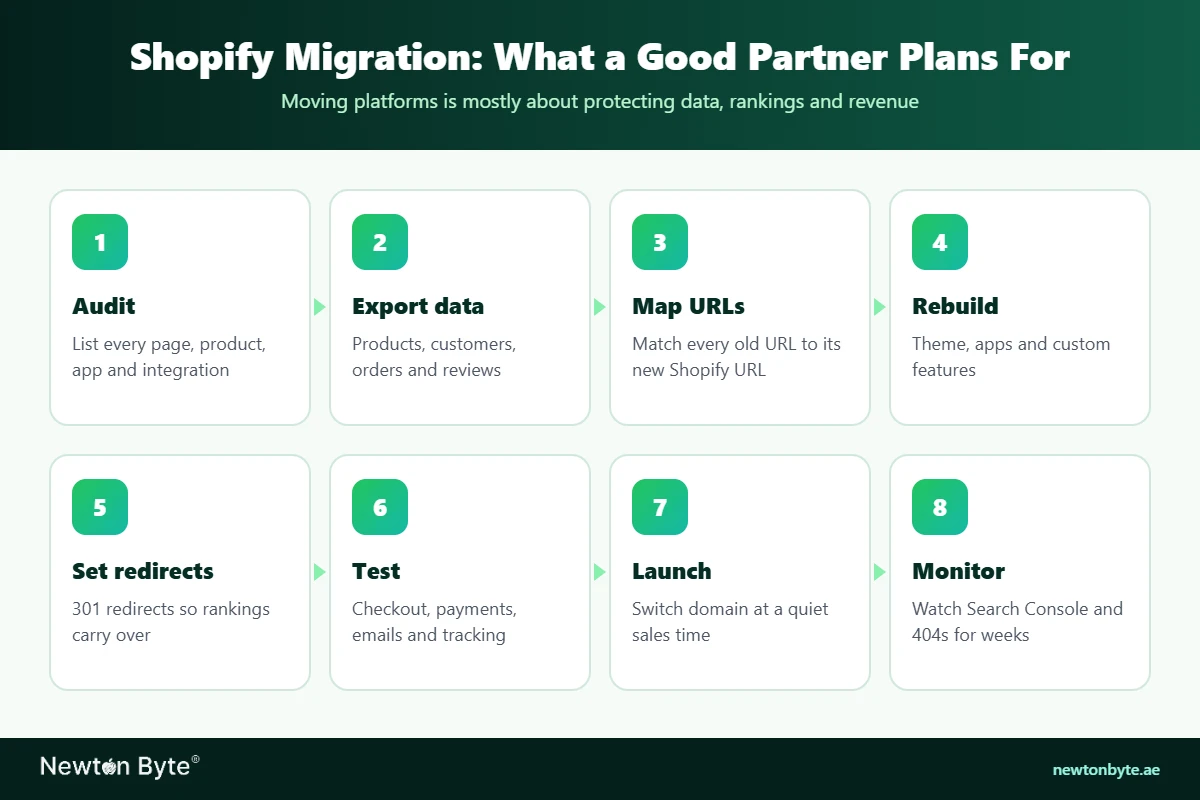
Moving to Shopify from another platform is where inexperienced Shopify partners cause the most damage. Three details are worth asking about directly:
- URL changes: Shopify uses its own URL structure, such as /products/ and /collections/, so most of your old links will change. Every important page needs a 301 redirect, or you risk losing Google rankings you’ve spent years building.
- Customer accounts: customer passwords can’t be moved between platforms. Your partner should plan how customers will reactivate their accounts, usually with a friendly invite email after launch.
- Order history and reviews: decide in advance what history you need to keep and how product reviews will be carried over.
Ask any partner to walk you through their redirect plan before you sign. If you’re weighing platforms first, our guide on whether WooCommerce is right for your store covers the trade-offs, and our article on protecting SEO during a redesign explains the redirect side in more detail.
Protect Your Store: Access, Ownership and Contracts
This part gets skipped more than any other, and it’s the one that causes the biggest headaches when a relationship ends.
- Use collaborator access, not your login. Collaborator access lets Shopify partners work in your store while you choose exactly what they can see and change. Never share your store owner password. You can also require a collaborator request code in your store’s settings, so nobody can request access without it.
- Keep ownership in your name. The Shopify account, your domain and your payment gateway should all be registered to your business, not the agency.
- Pay for apps yourself. App subscriptions should be billed to your store, so they keep working if you change partners.
- Put code ownership in writing. Your contract should say that you own the custom theme code and design files once you’ve paid.
- Ask for a handover document. A short list of installed apps, custom code and logins makes it easy for anyone to support the store later.
Green Flags and Red Flags to Watch For
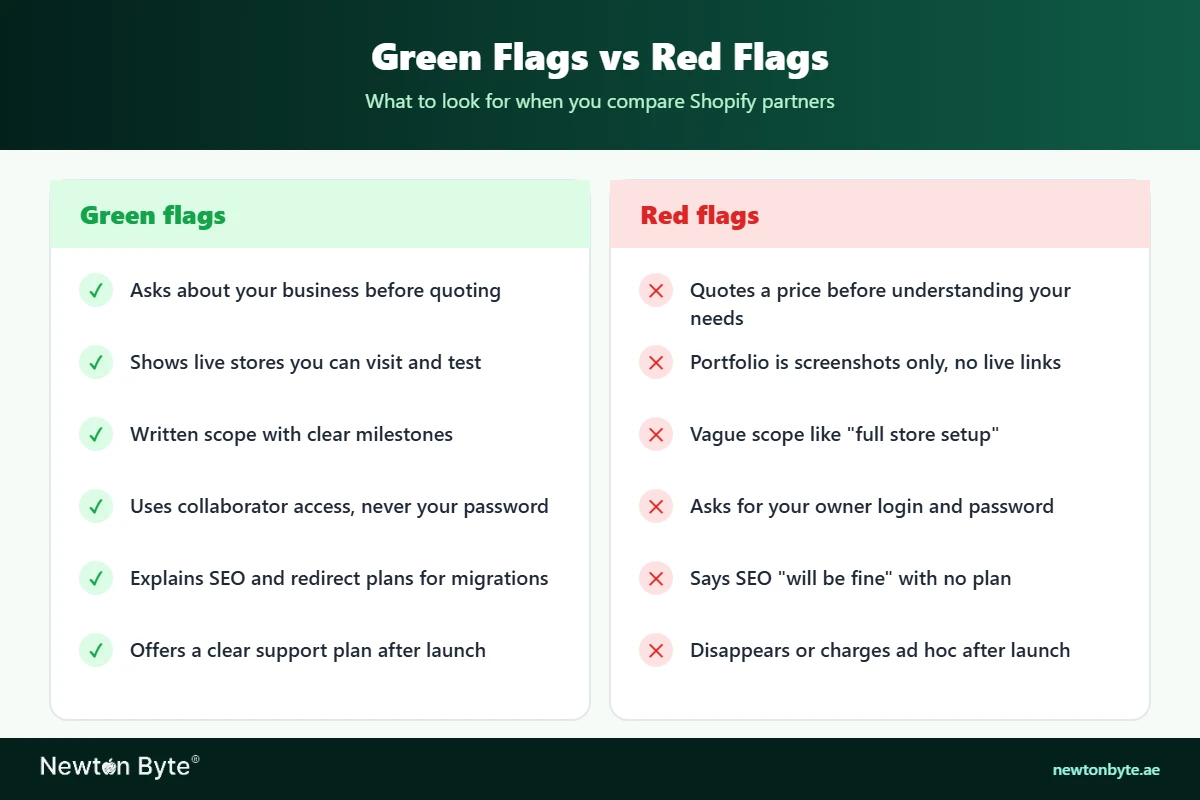
When you compare Shopify partners, one red flag on its own isn’t always a deal-breaker, but two or three together usually are. The strongest green flag of all is a partner who asks more questions than they answer in the first call.
Plan Ongoing Store Support Before You Sign
Launch day is the start of your store’s life, not the end of the project. Shopify releases updates, apps change, and you’ll want new features as you grow. Agree on support before the build starts, while you still have negotiating power.
Good ongoing store support usually covers:
- Bug fixes and small content or design changes
- Theme and app updates, checked before they reach customers
- Speed and mobile performance checks
- A quarterly review of installed apps to cut unused subscriptions
- Clear response times, especially for checkout or payment problems
Ask whether support is a monthly plan with a set number of hours or billed hourly when you need it. Monthly plans tend to suit stores that change often, while hourly works for stores that rarely need help. Our maintenance and support plans are built around exactly these tasks.
Should You Choose a Local Partner in the UAE?
You don’t have to hire local Shopify partners, but it helps. A UAE-based partner already understands cash on delivery, local couriers, buy-now-pay-later options like Tabby and Tamara, Arabic and right-to-left layouts, and the 5% VAT setup. They also work in your time zone, which matters when something breaks during a sale. If you hire remotely, make sure there’s a named contact and agreed working hours that overlap with yours.
Many of the same rules apply to hiring any web agency, as covered in our guide on choosing a web design agency in Dubai without getting burnt.
Frequently Asked Questions About Shopify Partners
How much do Shopify partners charge?
What Shopify partners charge depends on the scope, the partner’s experience and where they’re based. A simple theme setup costs far less than a custom build or a large migration. Send the same brief to three partners and ask for a fixed quote with a clear list of what’s included, so you can compare fairly.
Do I need a Shopify partner, or can I build the store myself?
Many small stores start on their own with a ready-made theme. A partner becomes worth it when you need a custom design, integrations, or a migration or simply want the store set up correctly the first time.
Do I need a Plus, Premier or Platinum partner?
Only if you’re a larger business, or you’re on Shopify Plus with complex requirements. Most small and mid-sized stores are well served by experienced Select partners or skilled independent agencies.
How long does a Shopify store setup take?
A straightforward store can launch in a few weeks once your products, photos and content are ready. Custom features and migrations take longer. Content is often the real bottleneck, not development.
Can a new partner take over a store someone else built?
Yes. A good partner will start with a short audit of your theme, apps and custom code before promising anything. This is also where a handover document from your previous partner saves time and money.
Choosing the Right Shopify Partner for Your Store
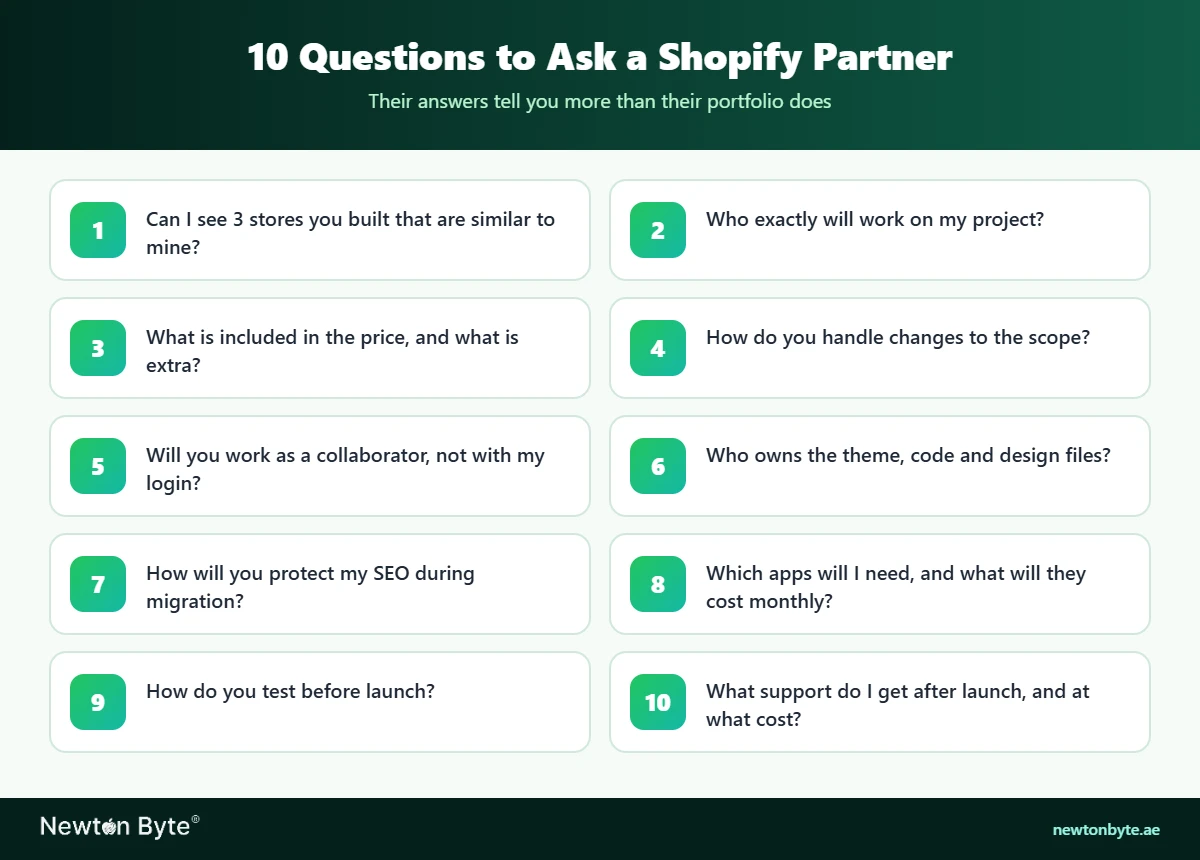
Write a clear brief, shortlist three Shopify partners, visit their live stores, ask the ten questions above, and get everything in writing, including who owns what and how support works after launch. Do that, and you’ll avoid the most common and expensive mistakes merchants make.
If you’re new to online selling, our guide on what ecommerce is and how an online store works is a good place to start. And if you’d like an honest opinion on your plans, Newton Byte offers Shopify development for UAE businesses, from store setup and migration to ongoing support. Get in touch, and we’ll tell you exactly what your store needs and what it doesn’t.