


Quick Answer
| YouTube and Display ads reach UAE audiences before they start actively searching. YouTube ads run as video, in three main formats: skippable, non-skippable, and bumper. Display ads run as banners across millions of websites and apps. Both work best as a top-of-funnel channel that warms people up, then hands them to Search and remarketing to close the sale. Used well, they build brand awareness. Used badly, they burn budget on views nobody remembers. |
Why These Two Channels Belong Together
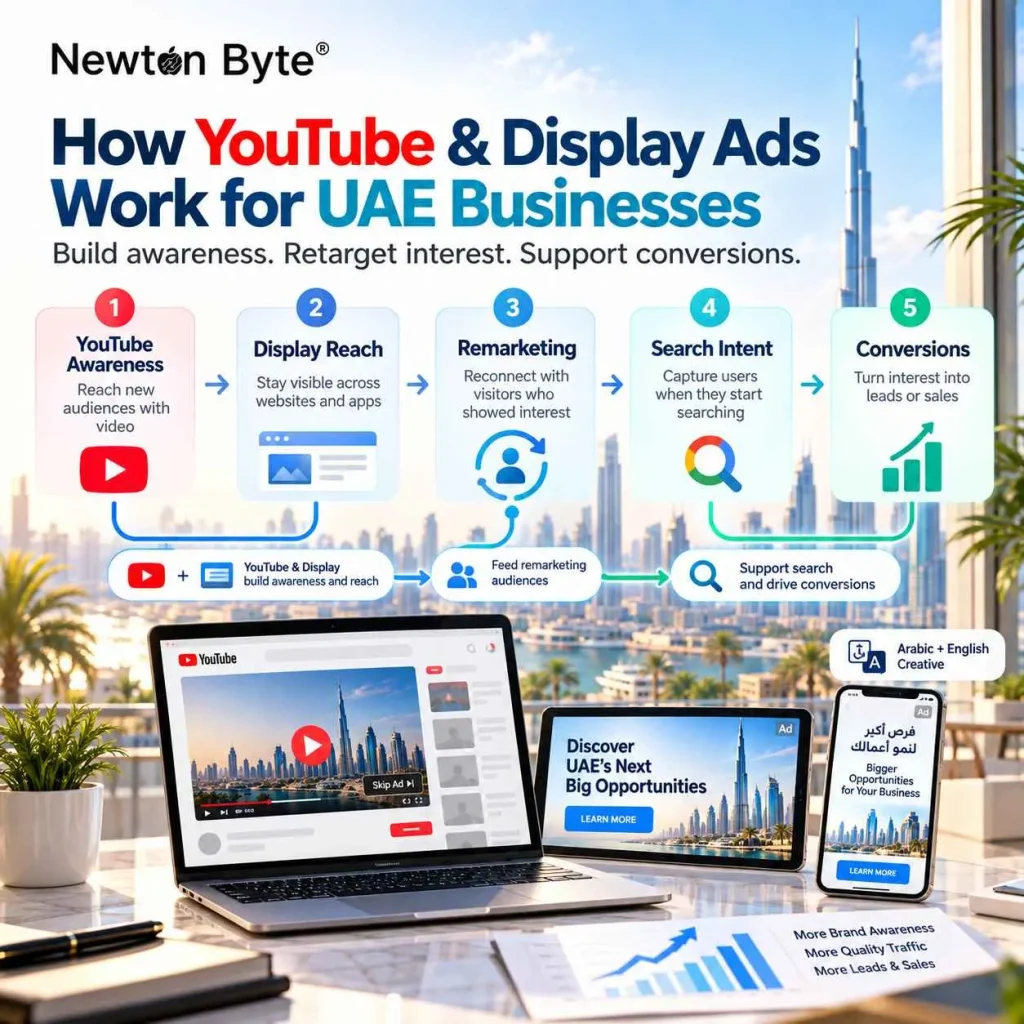
YouTube and Display often get treated as separate line items. In practice, they do similar jobs. Both reach people before they’re actively searching. So, both work through the Google Display Network. Both are priced differently from Search, view-based or impression-based, not click-based.
For a UAE business, this matters. Search captures demand that already exists. YouTube and Display help create that demand in the first place.
YouTube or Display First? A Simple Way to Decide
Neither channel is automatically the right starting point. The decision usually comes down to what assets already exist and what stage the business is at.
- A business with strong video content, product demos, testimonials, behind-the-scenes footage, usually gets more from YouTube first.
- A business with strong photography but no video, retail, real estate listings, hospitality, often gets more from Display first.
- A business with neither yet is usually better served starting with Search, then building creative assets before investing heavily in either channel.
Most mature UAE accounts eventually run both together, since they reinforce each other rather than compete for the same budget.
Why UAE Audiences Respond Well to Video and Display
YouTube is one of the most visited sites in the UAE. It behaves like a second search engine for many users, not just an entertainment app.
- UAE viewers increasingly watch YouTube on smart TVs, not only phones. That changes how a video ad needs to look and sound.
- Video consumption in the UAE is genuinely high across age groups, which makes YouTube a real awareness channel, not a niche one.
- Display reaches those same users later, on other sites, reinforcing a message they’ve already half-noticed once.
- Mobile usage dominates browsing time in the UAE. A Display ad built only for desktop screens loses a large share of its audience before it’s even seen properly.
- A large expat population means many UAE audiences move between English and Arabic content in the same day. Creative built for only one language misses part of the market.
YouTube Ad Formats, Explained Simply
There are three formats worth knowing before building a campaign.
- Skippable in-stream ads play before, during, or after a video. Viewers can skip after five seconds. Good for leads, sales, or traffic when there’s a clear offer.
- Non-skippable in-stream ads are short and must be watched in full. Best for pure awareness, when guaranteed exposure matters more than a click.
- Bumper ads are six seconds long and can’t be skipped. Ideal for reminders, remarketing, or reinforcing one single message.
Each format serves a different stage. Skippable ads suit people close to a decision. Bumper ads suit people who already know the brand and just need a nudge.
What Display Ads Actually Are
Display ads are image or banner ads. They appear on websites and apps across the Google Display Network, not on Google’s search results page.
A Display campaign can reach a huge number of sites at once. That reach is the strength. It’s also the risk, since a poorly targeted Display campaign can burn budget on placements nobody notices.
Display Ad Formats and Placements
Display isn’t just one static banner shape. A few formats matter most for a UAE campaign.
- Responsive display ads automatically resize to fit whatever space is available, a news site sidebar, a mobile app banner, or a native-style slot inside an article. This is the most common starting format, since one set of assets covers many placements.
- Static image ads give full creative control over exact sizing and layout. Useful for a brand with strict visual guidelines, but more work to produce across every required size.
- Native-style ads blend into the look of the site or app they appear on. They tend to get noticed less as an obvious ad, which can raise engagement for softer, awareness-focused messages.
Placement choice matters as much as format. Broad placement across the entire Display Network reaches the most people, but often the wrong people. Narrower placement, specific sites, specific apps, specific topics, reaches fewer people who are more likely to actually care.
Creative Best Practices for UAE Campaigns
- Build the hook into the first five seconds of any skippable video. If a viewer can skip and does, the message needs to have already landed by then.
- Keep banner text short. A Display ad seen for a second or two on a busy news site needs to communicate one idea, not three.
- Produce Arabic and English versions separately, not as a direct translation of the same script. Tone and pacing that work in English rarely land the same way in Arabic.
- Design for both a phone screen and a smart TV. A banner that looks fine on mobile can look cramped or oversized on a much bigger display.
- Refresh creative regularly. The same video or banner shown for months loses effectiveness as the same audience sees it again and again. Cost per result tends to creep up as a result.
Targeting Options That Matter for UAE Campaigns
- Demographics: age, gender, location, and household income where available.
- In-market audiences: people actively researching a product category right now, not just casually interested.
- Custom intent audiences: built from actual search keywords, useful for connecting YouTube back to Search intent.
- Life events: people who recently moved, graduated, or got married, relevant for real estate, education, and retail.
- Remarketing: people who already watched a video, visited a website, or engaged with a channel.
Precision beats size here. A smaller, well-matched audience usually outperforms a broad one, even though the broad one looks more impressive on paper.
Remarketing: Where YouTube and Display Actually Earn Their Keep
Cold traffic rarely converts on the first exposure. Remarketing is what brings people back.
Google requires a minimum audience size before a remarketing list becomes usable, roughly 100 users for Display remarketing, and 1,000 for Search remarketing lists. A brand-new UAE website often needs a few weeks of traffic before remarketing can even switch on properly.
Dynamic remarketing goes a step further. Instead of a generic ad, it shows the exact product or service someone already viewed. A traveller who checked flight prices for a specific route can be shown an ad for that exact route and fare, not a generic “book now” banner. That level of specificity is what actually drives people back.
- Real estate: remind a buyer of the exact listing they viewed.
- Automotive: show the exact model and trim a visitor browsed.
- Ecommerce: recall the exact product left in a cart.
A UAE-Specific Channel Most Guides Skip: WhatsApp Retargeting
A lot of UAE businesses drive enquiries through WhatsApp, not just web forms. Someone who clicks a WhatsApp button but never sends a message is a real remarketing opportunity. So is someone who starts a chat and goes quiet. Most Display strategies ignore this entirely.
How to Measure Whether These Campaigns Are Working
Views and impressions are the easiest numbers to report, and the least useful ones on their own.
- View rate shows whether the creative actually holds attention, not just whether it was shown.
- Cost per view (CPV) and cost per thousand impressions (CPM) show what attention is actually costing, and both move with UAE seasonality.
- Watch time and completion rate reveal whether people stop watching in the first few seconds or stay through the message.
- Assisted conversions, visible in GA4, show how many Search or direct conversions a YouTube or Display exposure helped produce, even without a direct click.
A campaign judged only on clicks will almost always look weak, since that was never the primary job these two channels do well.
Realistic Budget Guidance for a UAE Campaign
There’s no single correct starting number, but a few patterns hold across most UAE accounts.
- A very small daily budget spreads too thin across the Display Network’s huge inventory to produce meaningful data.
- YouTube’s cost per view is normally lower than a Search click, which makes it a reasonable channel to test awareness on a modest budget before scaling.
- Budget should rise during known UAE peak periods: Ramadan, Dubai Shopping Festival, back-to-school. Staying flat all year quietly underperforms during the weeks that matter most.
Timing and Seasonality in the UAE
YouTube ad costs aren’t flat across the day or the year.
- Evening hours, roughly 7 PM to 11 PM, see the highest competition. More advertisers bid for the same attention, which pushes cost up.
- Ramadan and Dubai Shopping Festival both push CPV and CPM higher temporarily, since demand for the same inventory spikes across the whole market.
- Narrow, high-intent audiences cost more per view but tend to convert better than broad, cheap reach.
Common Mistakes UAE Businesses Make With YouTube and Display
- Treating YouTube as a standalone channel instead of connecting it to Search, Display, and remarketing.
- Sending video traffic to a generic homepage instead of a landing page that matches the ad’s message.
- Judging a campaign only on views or impressions, instead of view rate and downstream conversions.
- Uploading one video and leaving it untouched for months. Fresh creative keeps cost down and engagement up.
- Skipping remarketing entirely, and paying full price for cold traffic on every single exposure.
- Running identical creative in English and Arabic instead of writing each version separately for how that audience actually speaks.
- Ignoring smart TV viewers and designing only for a small mobile screen.
How Newton Byte Approaches YouTube & Display for UAE Clients
Newton Byte treats YouTube and Display as connective tissue, not standalone campaigns. Video and banner exposure feed remarketing lists. Those lists feed Search and, where relevant, Performance Max. The goal is one connected journey, not three disconnected budgets.
That means creative gets built in English and Arabic separately from the start. Remarketing gets switched on the moment an audience is large enough to use. Budget gets adjusted ahead of known UAE peak periods, not after they’ve already passed. For the full managed service, see YouTube & Display Ads Management UAE.
The Short Version
YouTube builds awareness through video. Display extends that awareness across the web through banners. Neither is built to close a sale alone. Both work best feeding into remarketing, then into Search, where the actual decision usually happens. Get the sequence right, and these two channels stop being a cost center and start being where the rest of the account gets its easiest, cheapest conversions.
Frequently Asked Questions
Neither works well in isolation for a very small budget. Most small UAE businesses get more value starting with Search, then adding YouTube or Display once there’s enough website traffic to build a remarketing audience.
Cost per view typically runs low compared with a Search click, but it rises during peak evening hours and during Ramadan or Dubai Shopping Festival. A skipped ad within the first five seconds usually isn’t charged at all.
Google requires roughly 100 users for a Display remarketing list and 1,000 for a Search remarketing list before the list becomes usable. A new site often needs a few weeks of traffic first.
It depends heavily on targeting. Broad, untargeted Display campaigns do get ignored. Well-targeted remarketing Display, shown to people who already visited the site, performs very differently and often carries the lowest cost per conversion in an account.
Yes. Real estate, education, clinics, and professional services all use YouTube effectively, usually for awareness and remarketing rather than as a direct, one-step path to a sale.
Separate creative works better than a direct translation. Pacing, tone, and even the length of the hook that works in English rarely transfers well into Arabic without real adaptation.
Check view rate and average watch time in the campaign report. A high skip rate in the first five seconds usually means the hook needs work, not that the whole format is wrong for the business.