


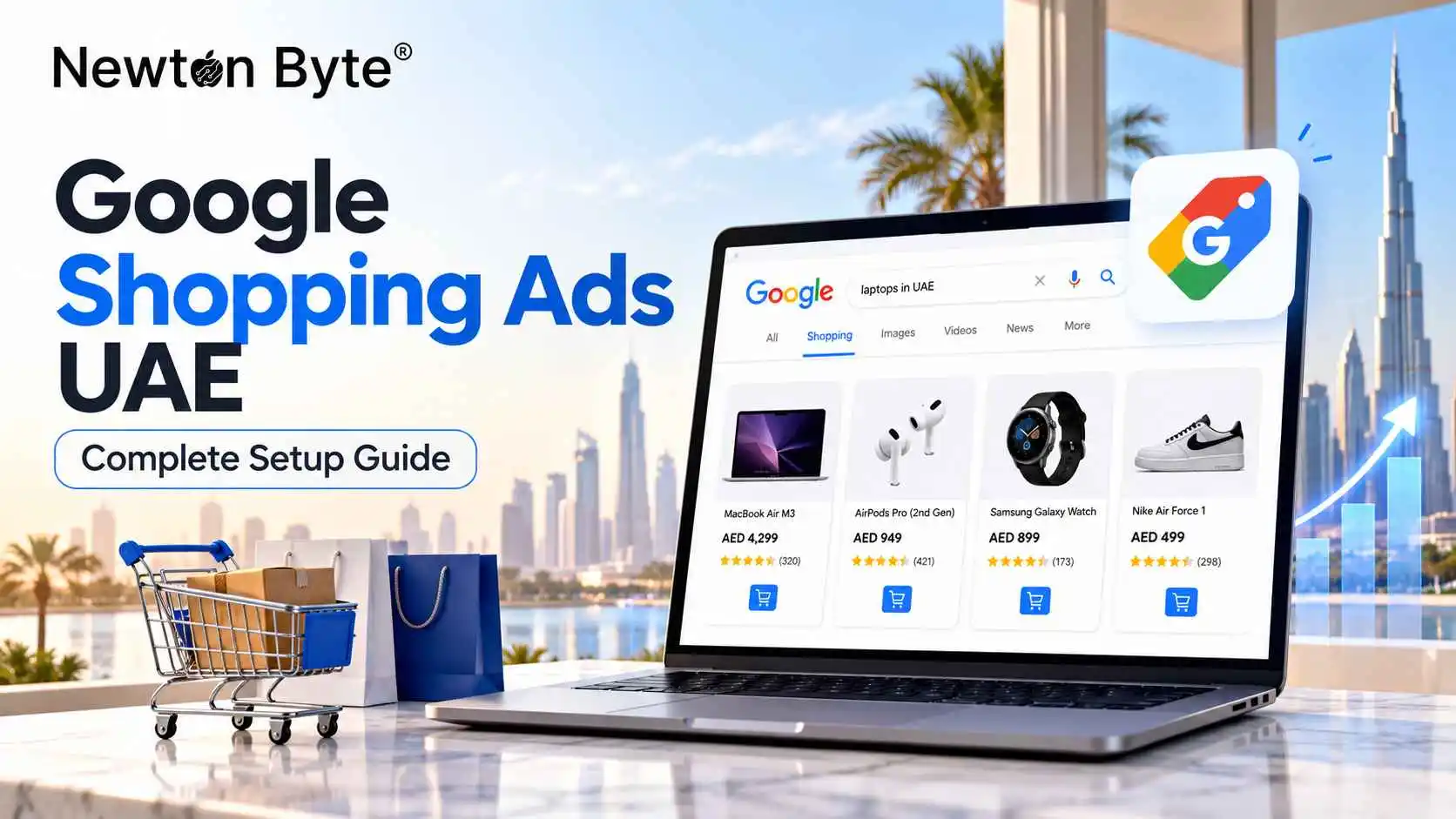
Quick Answer
| Google Shopping Ads show product images, prices and store names directly inside Google’s search results, ahead of text ads and organic listings. Setting them up correctly for a UAE store means verifying a Google Merchant Center account with real trade licence details, building a feed with VAT-inclusive AED pricing, and getting the feed approved before optimizing it. For UAE-specific trust, the feed and the actual checkout experience, payment methods, shipping claims, and who the legal merchant of record is, need to match exactly. |
What Google Shopping Ads Actually Are
Google Shopping Ads are product listing ads. That pull directly from a store’s product feed rather than from written ad copy. When someone searches for a product, Google shows a visual block of matching listings, image, price, and store name. Ahead of both text ads and organic results.
For a UAE ecommerce business, that visual placement matters more than the description suggests. Shopping ads are commonly cited as generating the large majority of paid clicks for retail searches on Google. Which means a store not running them is largely invisible. At the exact moment someone is ready to buy, not just browsing.
Why Shopping Ads Are a Real Opportunity in the UAE Specifically
Google Shopping is still comparatively underused by UAE ecommerce businesses compared with markets like the UK, US, or Australia. That means the auction, while genuinely competitive, isn’t yet saturated the way it is in some Western markets. For a store with a clean feed, decent product photography, and reasonable pricing. There’s real room to capture high-intent UAE product searches without paying the inflated CPCs seen elsewhere.
Setting Up Google Merchant Center for a UAE Business
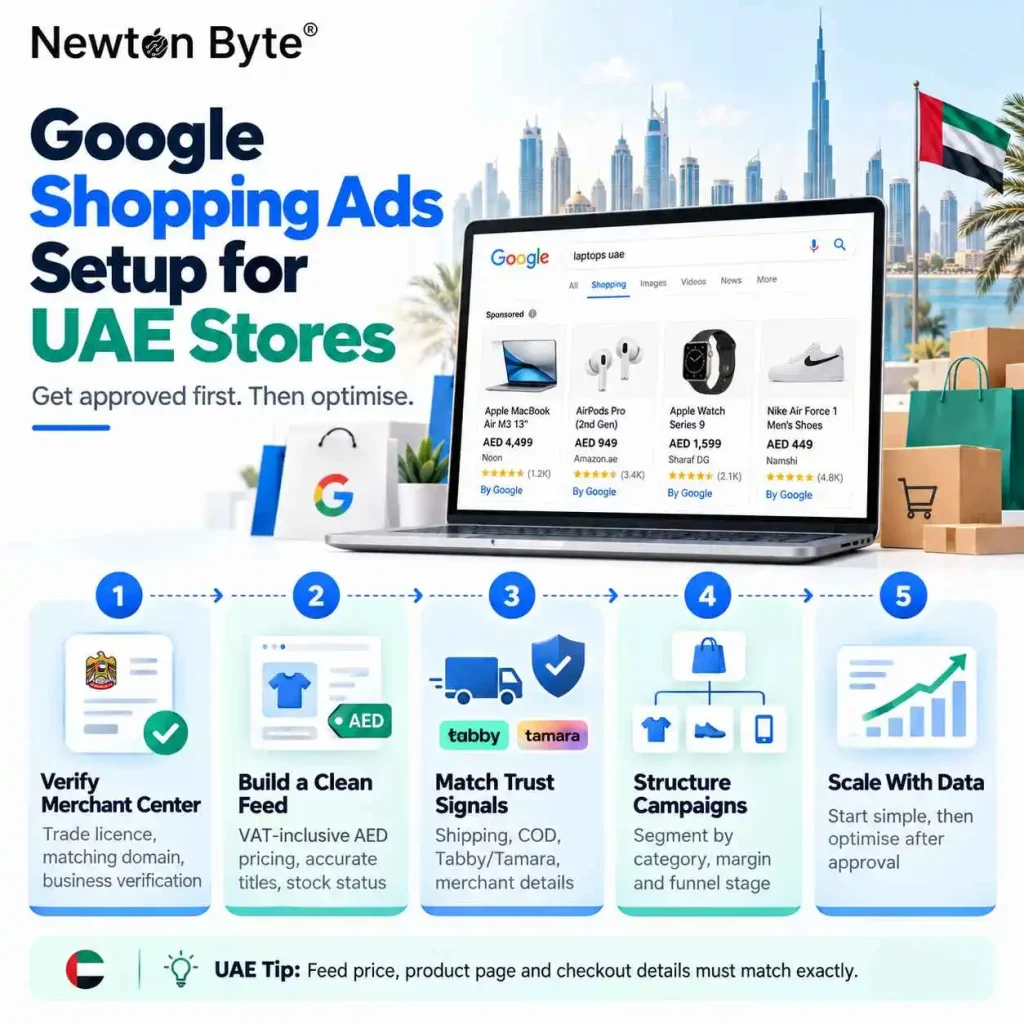
Before a single Shopping ad can run. A business needs a verified Google Merchant Center account, and verification in the UAE has a few specific requirements worth knowing before starting:
- Trade licence details matching the business’s registered legal name
- A website URL that matches the domain exactly, including whether it’s www or non-www, since a mismatch here is a common cause of failed verification
- Phone or postcard verification to confirm the business address
Getting this step right the first time avoids a delay that otherwise pushes an entire campaign launch back by days.
Building a Feed That Gets Approved First, Then Optimized
The most sound piece of sequencing advice found. While researching this guide is also the simplest: get the feed approved before spending time optimizing it. A feed doesn’t need to be perfect to pass initial review, it needs to avoid the specific issues that trigger disapproval.
- VAT clearly included in the displayed price. Since mismatched pricing between the feed and the actual checkout is one of the most common UAE-specific disapproval causes.
- Product titles and descriptions written the way UAE shoppers actually search, brand plus product type plus key attribute, rather than a generic template built for a different market.
- Accurate stock and availability data, checked regularly rather than uploaded once and left.
The UAE-Specific Trust Signals Most Guides Skip
| ⚠ This is the genuine differentiator for this post. Almost every other guide covers the technical feed mechanics; almost none cover whether the feed’s promises actually match what a UAE shopper experiences at checkout, which is where real trust, and real disapprovals, quietly get lost. |
A feed can be technically correct and still cost a store money if what it promises doesn’t match the real buying experience.
- Shipping honesty: a “ships from Dubai” claim, if true, meaningfully helps conversion. If it isn’t true, it becomes a refund and dispute problem instead.
- Cash on delivery accuracy: if COD is enabled, any related fees need to be reflected consistently. A high COD refusal rate at the door can quietly destroy the economics of a campaign that looks profitable on the first purchase alone.
- Buy-now-pay-later accuracy: Tabby or Tamara should only appear in ad creative or on the product page if checkout genuinely offers them for that specific product and cart size, not as a blanket claim.
- Free-zone and cross-border clarity: for sellers operating through a free zone or shipping cross-border, being clear about who the actual merchant of record is affects both trust and compliance.
- Bilingual consistency: where an Arabic version of the store exists, the feed language and the landing-page language need to align. A mismatch here is a quiet conversion killer that rarely shows up in the metrics as an obvious cause.
Structuring Shopping Campaigns
A flat, catalogue-wide campaign makes it difficult to bid intelligently across very different products. A more workable structure segments by margin tier, so higher-margin products can support more aggressive bidding than clearance stock, and by funnel stage, separating branded searches, generic category searches, and remarketing to previous visitors into distinct campaigns rather than one undifferentiated group.
Standard Shopping vs. Performance Max
Standard Shopping campaigns give more direct control over bids and placements, which makes them a reasonable starting point for a new UAE store that wants to see exactly which products and search terms are producing sales. Performance Max extends the same feed automatically across Search, Display, YouTube and Discovery, and tends to perform better once a store has enough conversion history for the algorithm to learn from. For the full setup detail on that side, see Performance Max for UAE Businesses.
Budget and Bidding for a New UAE Shopping Campaign
Starting small and scaling with real data outperforms launching with an aggressive automated bidding strategy from day one. A conservative starting approach, gathering clicks and initial conversion data before introducing a Target ROAS goal, gives the account something real to optimize toward rather than a guess.
Common Mistakes UAE Stores Make With Shopping Ads
- Displaying a price in the feed that doesn’t match VAT-inclusive checkout pricing, which triggers disapprovals and erodes trust when a shopper notices the difference.
- Claiming payment methods or delivery promises in creative that the actual checkout doesn’t consistently offer for that product.
- Running one flat campaign for the entire catalogue instead of segmenting by margin or funnel stage.
- Leaving an Arabic-language storefront’s feed and landing pages out of sync with each other.
- Trying to optimize a feed’s copy and images before it has even passed initial Merchant Center approval.
How Newton Byte Approaches Shopping Ads for UAE Stores
Newton Byte treats the feed and the actual checkout experience as one connected system, not two separate jobs. That means verifying Merchant Center correctly the first time, getting the feed approved before polishing it. And checking that shipping, payment and pricing claims match what a UAE shopper actually experiences at checkout, before ever discussing bidding strategy. For the full managed service, see Ecommerce UAE.
Frequently Asked Questions
Yes. Merchant Center is where the product feed lives. And it has to be verified with real UAE business details, trade licence, matching domain, and phone or postcard confirmation, before any Shopping campaign can launch.
Because the price shown in the feed has to match what a shopper actually pays at checkout. A feed price that doesn’t include VAT. The way the live site does is one of the most common disapproval triggers for UAE stores specifically.
Standard Shopping is usually the more sensible starting point. Since it shows clearly which products and search terms are actually producing sales. Performance Max tends to work better once that data already exists.
There’s no single fixed number, but starting small and scaling based on real conversion data outperforms. Launching with an aggressive budget and an automated bidding target on day one, before the account has anything to learn from.
It can, indirectly. A high COD refusal rate at the door can make a campaign that looks profitable on paper far less profitable in reality. So COD-related fees and expectations need to be reflected consistently across the feed, product page, and checkout.
Related Reading