


Quick Answer
| Performance Max is Google’s automated campaign type that serves ads across Search, Display, YouTube, Gmail, Maps and Discover from one campaign, using machine learning to optimize toward a conversion goal. For UAE businesses, it works well once conversion tracking is verified, the product feed or lead data is clean, and there’s enough real conversion volume for the algorithm to learn from. It performs poorly when launched on a broken foundation, and no amount of budget fixes that. |
What Performance Max Actually Is
Performance Max is a single, goal-based campaign type. Instead of building separate Search, Display, YouTube and Shopping campaigns and managing each one’s bids independently. A business provides assets, a product feed where relevant, and a conversion goal. Google’s automation decides which channel, which creative, and which audience to use for each auction.
According to Google’s own documentation, Performance Max is recommended when a business has a specific conversion goal. It wants to access Google’s full advertising inventory from one campaign, and wants to extend reach beyond what keyword-based Search campaigns alone can capture.
Why Performance Max Matters More in a Market Like the UAE
The UAE runs one of the most competitive digital advertising markets in the world. Running five separate manual campaigns to cover Search, Shopping, Display and YouTube. That is expensive in both ad spend and management time, and Performance Max consolidates that reach under one optimization engine.
But the same competitiveness that makes PMax attractive. Also makes a weak setup more costly here than in a less contested market. A campaign with no real signal to learn from doesn’t just underperform, it can spend a meaningful daily budget finding the cheapest available clicks, which are rarely the ones that convert.
The Setup Order That Actually Matters
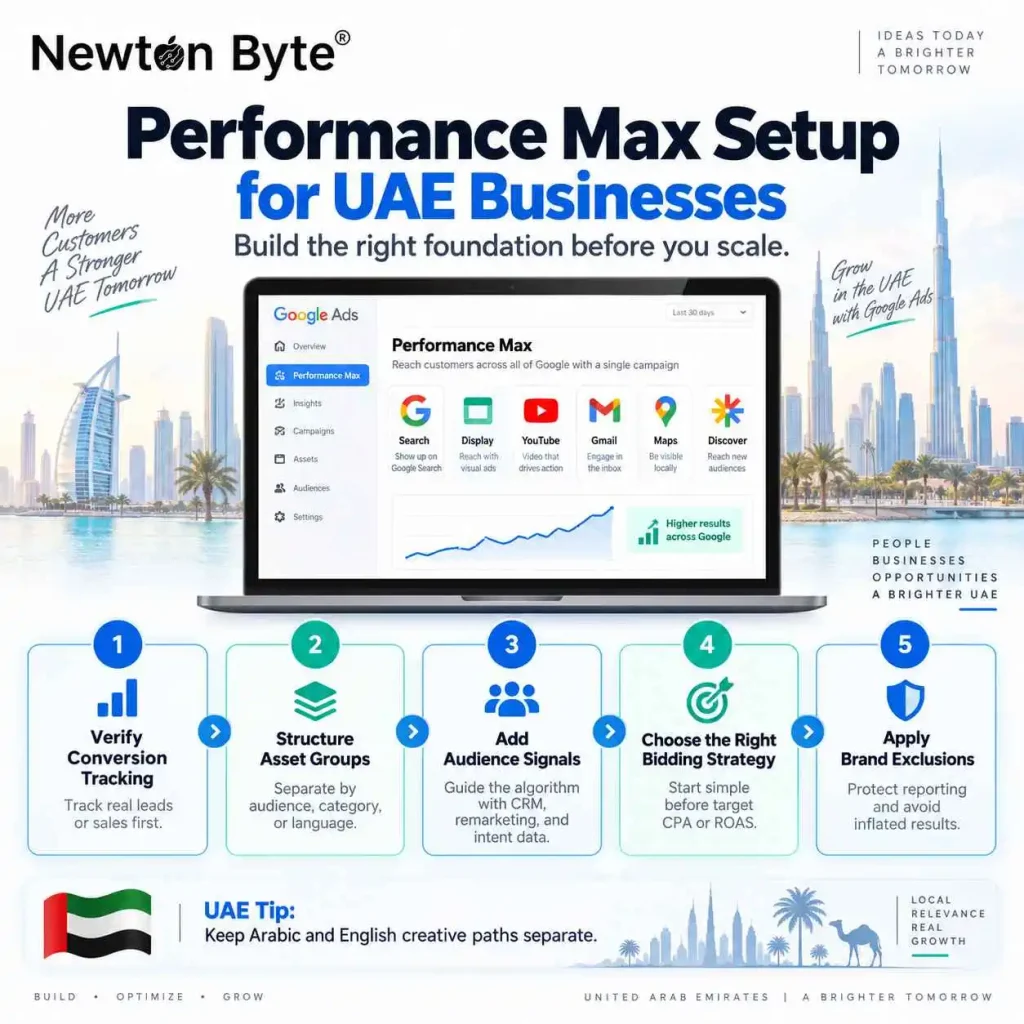
Performance Max rewards being built in a specific sequence. Skipping ahead is the most common reason a new UAE campaign underperforms in its first month.
- Conversion tracking first. Before anything else, verify that the account’s primary conversion action is tracking real outcomes, not a page view or a “thank you” URL that could be reached without an actual submission. Only one action should be marked “Primary”; everything else should be set to observe only.
- Then asset groups. Each asset group should represent one clear audience or product category, not a catch-all for the whole business.
- Then audience signals. These guide Google’s early learning; they are not a targeting restriction.
- Then a bidding strategy. Setting an aggressive Target ROAS or Target CPA before the account has real conversion history tends to starve the campaign of the data it needs to learn.
Structuring Asset Groups for UAE Audiences
An asset group is the equivalent of an ad group in a Search campaign. A set of creative assets paired with the audience signals meant to guide who sees them first. The rule that shows up consistently across UAE practitioner guidance is the same one. Build separate asset groups for distinct audience segments or product categories, rather than one group covering everything.
Bilingual structure matters here specifically. Mixing Arabic and English creative inside the same asset group dilutes what the algorithm can learn from either language pool. Separate asset groups, or at minimum separate creative and landing paths. By language is the consistent recommendation across every UAE-specific source reviewed for this guide.
A reasonable minimum for a new asset group includes several distinct images, at least one logo, several headlines of varying length, and at least one long headline, tested against each other rather than submitted once and left alone. Google’s own asset strength indicator, which scores a group from “Poor” to “Excellent,” is a useful early signal of whether a group has enough genuine variety to work with.
Audience Signals That Work in the UAE
- Existing customer lists from CRM data, where available
- Website visitor remarketing audiences
- In-market audiences aligned with the actual product or service category
- Custom intent audiences built from a Search campaign’s own best-performing keywords
For location-specific UAE campaigns, adding a signal filtered to relevant job titles or company types (for a Business Bay or DIFC-focused B2B service, for example) gives the algorithm a sharper starting point than a broad demographic guess.
Choosing a Bidding Strategy
For a brand-new campaign with no historical data, starting with Maximize Conversions and no target set lets the algorithm gather data without a constraint that could cause under-delivery. Once the account has built up a real base of conversions, usually somewhere in the range Google itself recommends before introducing a target, a Target CPA or Target ROAS goal can be introduced.
- Target CPA fits a business where every conversion is roughly equal in value, a form fill or a booking, for example.
- Target ROAS fits a business where conversion values vary meaningfully, an off-plan property inquiry worth far more than a general one, for instance.
Brand Exclusions: A UAE-Specific Priority
Performance Max will bid on a business’s own brand name by default unless told not to. For an established UAE company, branded search can represent a significant share of total commercial search volume, which means an unexcluded PMax campaign can end up taking credit for traffic that would have converted anyway, inflating reported ROAS without adding real incremental revenue.
Adding a brand name, its common misspellings, and the business’s own domain as campaign-level negative keywords before launch is a small setup step with an outsized effect on how trustworthy the campaign’s reporting actually is.
Gulf Seasonality: The Calendar Automation Doesn’t Know About
Performance Max optimizes toward efficiency, not toward a business calendar. Ramadan, Eid, UAE National Day, Dubai Shopping Festival, White Friday, and events like Gitex all shift search volume, intent, and creative fatigue faster than in many Western markets, and the algorithm won’t anticipate any of it on its own.
- Launch seasonal creative and budget adjustments well ahead of a known surge, not on the day it starts, since the campaign needs time to learn the new pattern.
- Prepare Ramadan- or Eid-specific creative variants in advance rather than reusing year-round assets during the period UAE search behaviour changes the most.
- Watch single-asset spend concentration during peak periods specifically. A campaign leaning on one image or one offer for weeks tends to fatigue exactly when seasonal competition is highest.
Feed Hygiene for UAE Ecommerce
For any ecommerce business running Shopping-driven Performance Max, whether on Shopify, WooCommerce, Salla, or Zid, the product feed inside Merchant Center is doing more work than the campaign settings themselves. A handful of UAE-specific feed details matter more here than in many other markets:
- Pricing shown VAT-inclusive in AED, since mismatched pricing is a common cause of feed disapprovals.
- Bilingual product titles and descriptions, with English and Arabic clearly structured so both are usable rather than mashed into one field.
- Accurate availability and stock data kept current, particularly during high-velocity periods like Dubai Shopping Festival or White Friday.
The Learning Period: What to Expect
Most Performance Max campaigns need real time, commonly cited as somewhere around six to eight weeks in competitive vertical. To exit the learning period and produce stable, optimizable data. During the first one to two weeks specifically, fluctuating CPCs and inconsistent cost-per-conversion are normal, not a sign the campaign is broken.
Google’s own guidance is explicit that significant changes during this window. Editing budget by more than a small margin, switching bidding strategy, or swapping out assets, reset the learning clock. In a high-CPC market, that patience is genuinely difficult to sit through, but restarting the clock repeatedly is a more expensive mistake than the wait itself.
When Performance Max Is Not the Right Answer
- Conversion tracking isn’t reliably verified yet. Automation amplifies bad signal; it doesn’t fix it.
- Monthly conversion volume is very low. Below a certain threshold, the algorithm simply doesn’t have enough to learn from, and standard Search campaigns tend to outperform PMax until that data exists.
- The business needs tight, query-level control, common in regulated industries. B2B lead qualification, or specific offer testing, where PMax’s reduced manual control works against the goal.
- The product feed is chronically disapproved. Fixing Merchant Center comes before scaling any Shopping-driven PMax campaign, not after.
Common Mistakes UAE Businesses Make With Performance Max
- Launching without verified conversion tracking, so the algorithm optimizes toward clicks instead of real outcomes.
- Skipping brand exclusions and unknowingly paying for traffic that would have converted organically.
- Mixing Arabic and English assets inside a single asset group instead of separating them.
- Editing budgets or bidding strategy repeatedly during the learning period.
- Building one asset group for the entire business instead of separating by audience or category.
- Ignoring UAE seasonality and judging full-year performance against a campaign that was never adjusted for it.
How Newton Byte Approaches Performance Max for UAE Accounts
Newton Byte builds Performance Max campaigns in the same order this guide describes: conversion tracking verified first, asset groups structured by audience and language, brand exclusions in place from day one, and a genuine learning period respected before any scaling decision gets made. For a full breakdown of what that looks like as a managed service, see Performance Max Management UAE.
Frequently Asked Questions
There’s no single fixed number, but most practitioner guidance converges on a range: below roughly AED 8,000 to 10,000 a month, budget tends to spread across too many placements for the algorithm to learn from any of them properly. Competitive verticals like real estate or aesthetics often need meaningfully more.
At minimum, separate creative and landing paths. Many UAE accounts go further and use entirely separate asset groups by language, since mixing both in one group dilutes what the algorithm can learn from either audience.
Commonly six to eight weeks in competitive verticals before results stabilize, though this depends heavily on how much conversion volume the account generates. Editing the campaign repeatedly during this window is the most common reason that timeline stretches out further.
No. PMax is generally strongest alongside a dedicated brand Search campaign, not as a replacement for one. Removing Search entirely often means losing tight control over branded and highest-intent terms.
Because brand exclusions weren’t set at launch. Performance Max will bid on a business’s own name by default unless it’s added as a negative keyword at the campaign level. Which is why this is one of the first things worth checking on any UAE PMax account.