
People in the UAE don’t search for property the way they did in the past. Listings and glossy photos are not enough. Serious buyers, investors, and renters start with a search query, not a contact form. They want answers, clarity, and context before they call an agent. They want to feel understood.
That’s why Real Estate SEO in the UAE is not a side task. It’s the engine of visibility, relevance, and trust for property businesses that want real growth. SEO builds the bridge from curiosity to contact, from first glance to inquiry.
If your website doesn’t show up on the first page, you are invisible to most motivated searchers. That hits your bottom line directly. People trust what they find early online. They assume authority. They form impressions before they pick up the phone. A strong SEO strategy makes sure that your brand is the one they find, read, and trust.
This article explains how real estate SEO works in the UAE. We’ll cover how people search, what keywords matter, how content needs to look, and how to measure success without guessing. I’ll share real examples and practical ideas you can apply right now. And if you need guidance beyond this roadmap, Newton Byte has deep experience helping UAE property brands grow online.
How People Actually Search for Property in the UAE
Search behaviour matters more than you think. People don’t type broad phrases anymore and hope for relevant results. They type intent. They are specific, curious, or ready to act.
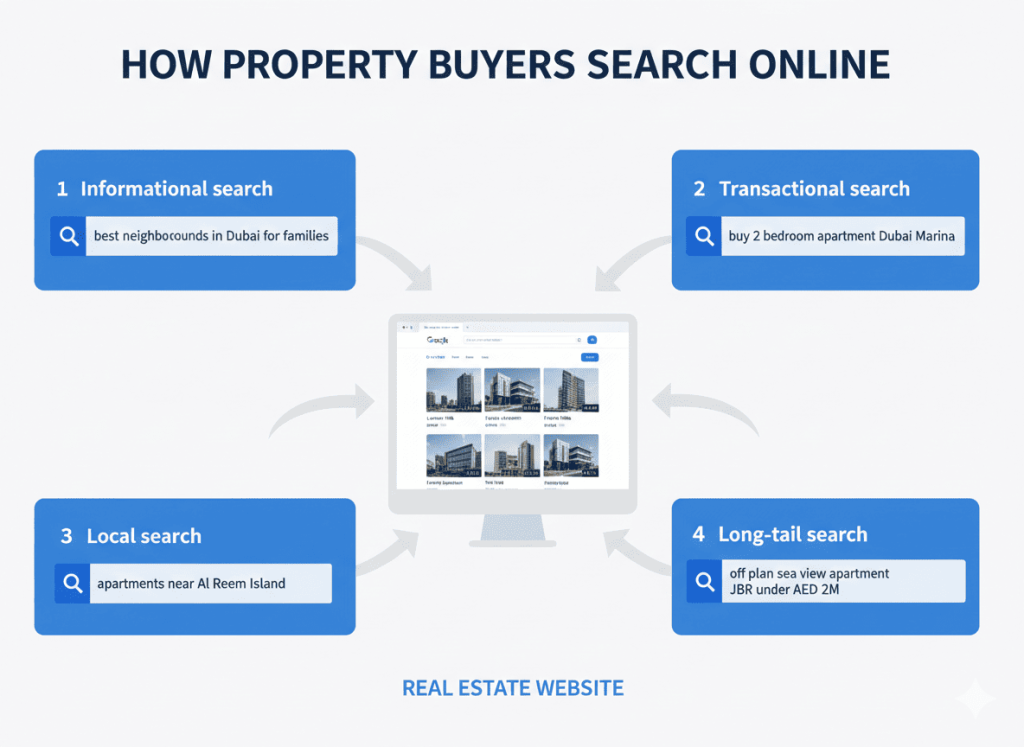
At the beginning of a property journey, someone might type “best neighbourhoods to live in Dubai with kids.” This is an informational search. It reveals a person in discovery mode, trying to understand where they want to settle. They are not ready to contact an agent yet. They want context, lifestyle insight, and comparisons.
At another point, people search “buy 2 bedroom apartment in Dubai Marina.” This is clearly transactional. It shows intent to act. People who use that wording are exploring actual properties they might buy. They are much closer to making a decision.
Local intent is crucial here. Someone in Abu Dhabi might search “properties for sale near Al Reem Island.” That’s a local search phrase with immediate practical relevance. It includes place, type of property, and often purchasing context without asking for it directly.
Long‑tail searches combine specifics with intent and context. For example: off‑plan sea‑view apartments for investment in Jumeirah Beach Residence under AED 2M. People who use such phrases are highly qualified. They know what they want. They have thought through budget, location, type, and purpose.
Good SEO recognizes these patterns. It builds content that matches what people actually type. The more your pages reflect real search behaviour, the more easily your brand appears in front of motivated users.
Why SEO Is a Core Growth Engine for UAE Real Estate
I want to be direct. The UAE property market is crowded. There are big portals, established agencies, international brands, and niche specialists. Paid advertising helps, but it stops working the moment the budget dries up. SEO continues to deliver long after the work is done, as long as you maintain it.
One agency in Dubai once told me they relied on social media and referrals alone. Their website barely received organic traffic. After we worked on content aligned with transactional and informational keywords, they started seeing meaningful traffic that converted. Within five months, organic enquiries doubled. Within nine months, half of their leads were coming from searches they never paid for.
People trust what they find in search engines. They assume credibility. That trust compounds with every piece of content they read. When your article answers a question, people feel understood. They associate that clarity with your brand. SEO builds this emotional connection long before the first phone call.
Keyword Strategy That Matches How People Search
Too many brands pick keywords based on guesses. They target what they think property buyers use. That rarely works. The key to strong SEO is matching your content to real search intent.
Let’s break down the four types of keywords that matter in real estate SEO:
Informational Keywords
These reflect curiosity and early research.
Examples:
- “What are the best areas to live in Abu Dhabi?”
- “How to buy property in the UAE as an expat.”
These phrases are research‑oriented. They require content that feels helpful, not salesy.
Transactional Keywords
These reflect readiness to act.
Examples:
- “Buy a villa in Palm Jumeirah.”
- “Dubai apartments for sale under AED 1.5M.”
Traffic that comes from these terms is closer to conversion. People are looking for options, prices, and next steps.
Local Keywords
These include specific places people care about.
Examples:
- “Townhouses in Jumeirah Village Circle.”
- “Rent apartments near Business Bay metro.”
People use these searches to find what’s nearby or where they want to live.
Long‑Tail Keywords
Long‑tail phrases are specific and detailed.
Examples:
- “Off‑plan 4-bedroom sea‑view apartment in Dubai for investment.”
- “Best real estate agent for luxury villas in Emirates Hills.”
These reflect high intent and often convert better because the user knows what they want.
A balanced SEO approach includes all four types. It captures early researchers, serious buyers, local searchers, and highly qualified prospects.
Content That Builds Trust and Drives Results
SEO isn’t about stuffing keywords into pages. Any AI can do that. Real estate SEO is about understanding the questions people carry in their minds when they search.
When someone types “rent vs buy in Dubai,” they want clarity. They want a real comparison. They want numbers and honest trade‑offs. A strong article will walk through both sides in clear language, with real examples of price ranges, lifestyle considerations, and even tax or fee implications in the UAE.
Another search might be “what documents do I need to buy property in Abu Dhabi?” Patients don’t want a sales pitch. They want answers that reduce uncertainty. When your content addresses these subtle emotional drivers) fear of complexity, desire for clarity, need for confidence, your brand becomes trustworthy.
Examples help. When writing about Downtown Dubai, don’t just say it’s popular. Talk about:
- Why families love it, closeness to schools and parks
- Why investors consider it, strong rental demand
- What recent price shifts have looked like
People can sense when content is generic versus grounded in real understanding.
Structuring Your Website for People and Search Engines
A common mistake is treating search traffic and user experience as separate things. They are not. Google measures user behaviour ( time on page, clicks, return visits) and uses that to decide whether your content is helpful.
Your site needs a logical structure. That means:
A homepage that speaks clearly. It should show what you do, where you operate, and who you help. It should feel human, not like a brochure.
City and area landing pages. Create dedicated pages for Dubai, Abu Dhabi, Sharjah, and key communities. Each should answer questions specific to that location.
Service and listing pages. These should be optimized for transactional and local keywords. They should reflect what people look for when they’re ready to act.
Educational content. Article pages that address informational and long‑tail searches build trust early in the journey.
Every link on your site should help people and search engines understand context and relevance. When internal links connect related articles and listings, users spend more time exploring. That tells Google your site is useful and authoritative.
Local SEO: Visibility in the Places That Matter
Healthcare and clinics may rely on local SEO, but real estate in the UAE is equally local. Someone searching “townhouses in Al Barsha” is in a different mindset than someone searching “UAE property market trends.” The first is rooted in proximity and practicality. The second is broad research.
Local search means:
- Optimizing for maps and local listings
- Adding neighbourhood pages
- Including metro stations, schools, and landmarks in your content
- Encouraging local reviews
Think like a local searcher: When I type “apartments near Dubai Marina metro,” I want options that match this exact need. The search tells you intent and context in one phrase. Your SEO should match it.
Technical SEO Worth Caring About
Technical SEO sounds intimidating, but it’s straightforward. It means your site is fast, secure, and easy to use on all devices.
Most property searches happen on phones. Slow pages lose people instantly. A user will bounce even if your content is perfect.
Secure sites (HTTPS) build trust. People share contact information only when they feel safe.
Clean URLs help search engines understand content without guesswork. A URL like:
/dubai‑marina‑apartments‑for‑sale
Is better than
/page?id=56789
Technical improvements do not show up instantly on dashboards, but they lay the foundation for everything else.
Authority and Why It Matters More in Real Estate
Real estate is emotional and expensive. People hesitate before they commit. They look for third‑party validation before they act. That’s where authority comes in.
Authority is not built by claiming expertise. It is built by showing evidence of relevance.
If your agency is mentioned in local property news, it signals real presence and credibility. If your content is referenced by other sites or blogs, it signals value. Being listed in reputable directories shows legitimacy.
Newton Byte has worked with clients who moved from obscurity to authority by pursuing genuine mentions. Not spammy links. Real citations in trusted local sources. That’s the kind of credibility Google rewards. And patients’ respect.
People don’t just read your content. They judge it against other voices they trust. Your SEO should make your content one of the voices they respect.
Measuring What Actually Matters
SEO metrics can feel overwhelming. Page views. Impressions. Rankings. But real estate businesses should focus on outcomes that matter to the bottom line.
Ask yourself:
- Are more qualified leads reaching out from organic search?
- Are people finding your listings and spending time there?
- Are neighbourhood pages converting into inquiries?
- Are you ranking for local and transactional terms that directly relate to your inventory?
When someone types “buy beachfront villa in JBR under AED 5M” ( a long‑tail phrase), and your site appears, that is meaningful visibility. When they click, read, and then contact you, that’s real success.
Measure behaviour, not just numbers. Pages that engage users are the ones that build trust and drive action.
Common Mistakes That Stall Real Estate SEO
I’ve seen great agencies sabotage their SEO without realizing it.
Some treat SEO like a one‑time task. They launch a few pages, then forget them. SEO is continuous. Markets change, search patterns evolve, and new inventory arrives.
Others focus only on generic terms like “UAE property” without honing in on intent. That brings traffic, but not leads.
Some copy content from portals. Search engines penalize duplicate material. Patients sense it too. They want fresh, specific perspectives.
And many ignore local context. The UAE is not one market. There are many micro‑markets with unique search behaviour. Your SEO should reflect that.
A Real Example: How Strategic SEO Changed a Brand’s Trajectory
A mid‑sized agency operating in Dubai and Sharjah struggled to gain traction online. Their website had listings, but few organic enquiries. They relied on referrals and ads.
When Newton Byte reshaped its SEO approach, we began with content aligned to real search intent. We prioritized long‑tail phrases like “3 bedroom off‑plan apartment near Business Bay for investment” and developed deep area guides that reflected real lifestyle questions. We added contextual content about community features, price expectations, commute times, and schools.
Within six months, organic traffic grew. More importantly, organic leads grew faster than paid leads. Their target audience began to find them early in the research process and stayed through to conversion.
This is the kind of real result SEO can bring when it is rooted in how people think, search, and decide.
Conclusion
Real estate SEO is not about manipulating search results. It is about engaging people before they commit to a decision. It is about reflecting empathy, clarity, and expertise in every piece of content.
When users search with curiosity or intent, your SEO should be ready to answer with relevance and honesty. That is the kind of visibility that turns into trust, contact, and long‑term relationships.
If you want support building a strategy like this, Newton Byte has the expertise to guide you from planning to real, measurable outcomes.
Frequently Asked Questions
SEO usually starts generating visible improvements within three to five months. Meaningful lead growth and organic visibility for competitive terms often appear between six and nine months of consistent work.
Broad keywords can build awareness, but they rarely convert alone. Focus on terms with clear intent (transactional, local, and long‑tail phrases) to attract qualified traffic that turns into leads.
Yes. Communities like Downtown Dubai, JVC, and Palm Jumeirah have unique characteristics. People search with local intent. Dedicated pages help you match that search behaviour and increase relevance.
Absolutely. Small agencies can outrank large portals by targeting specific intents and long‑tail keywords, offering depth and local expertise that portals cannot replicate at scale.
Reviews and local listings strengthen credibility and improve local search visibility. They give users confidence before they contact you, and search engines use them as signals of relevance and trust.