
Healthcare Clinic SEO UAE is one of the most personal decisions people make. It is often urgent. It is often emotional. In the UAE, patients don’t just search for healthcare services. They analyze them. They compare options and check reputations. Read before they reach out.
If your clinic appears only after someone scrolls past dozens of competitors, you have already lost trust. People decide before they call. They decide from search results and the content they find online.
That is why healthcare and clinic SEO in the UAE matters. It connects patients to your services at the exact moment they need reassurance, answers, and confidence. Its isn’t about tricks. It is about crafting content and an online presence that meets patients where they are.
This article goes deep into how healthcare SEO works in the UAE. It explains what patients search for, how Google reads your pages, and what practical steps clinics should take to show up first and convert better. If you want help implementing this, Newton Byte is one of the best agencies to guide you. We focus on real results, not buzzwords.
How Patients Search for Healthcare Services in the UAE
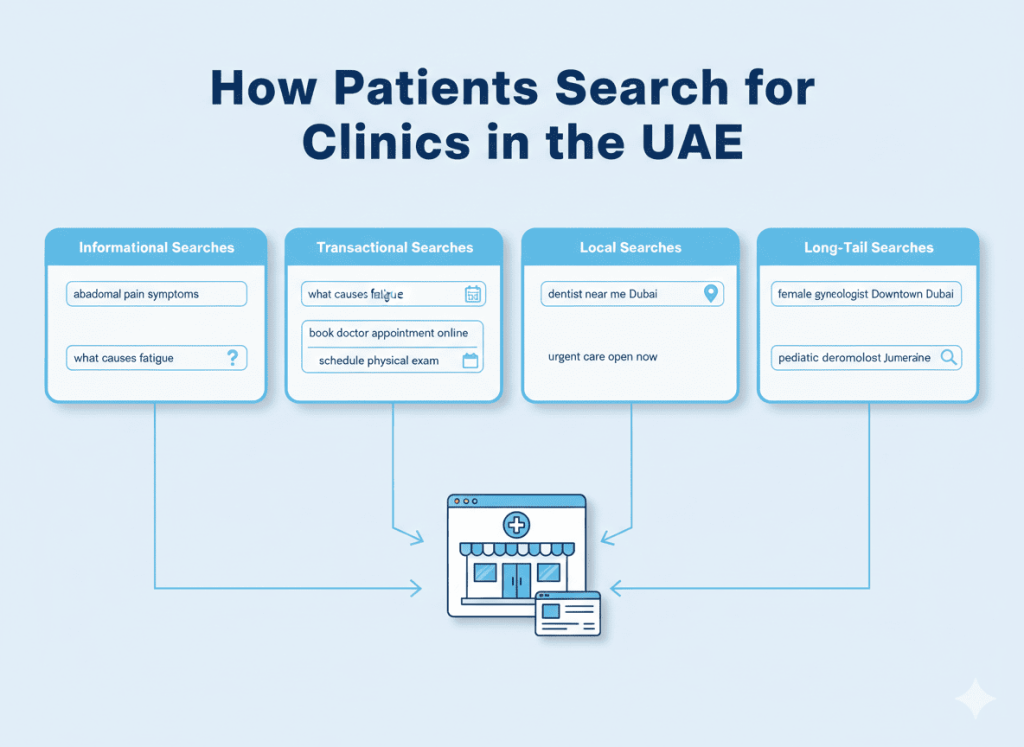
Patients do not search the same way for clinics as they do for products. Emotions, urgency, and clarity matter first. People use different kinds of search phrases based on what they need.
You can group searches into four types of keywords that matter most:
1. Informational keywords
These show a person who wants to understand a health issue or treatment before acting.
Examples: what causes back pain, symptoms of thyroid imbalance
These searches tell you the user is learning, not ready to book yet.
2. Transactional keywords
These show intent to act now. Patients want to book or find care.
Examples: book a dental appointment in Dubai, eye clinic in Abu Dhabi appointment
These are high-value because the user is ready to contact or visit.
3. Local keywords
Healthcare is local by nature. People want help near them.
Examples: urgent care clinic in Al Barsha, pediatric doctor near Jumeirah
These searches link location and service. Optimizing for local phrases helps clinics dominate nearby queries.
4. Long-tail keywords
These include specifics and often show higher conversion potential.
Examples: female gynecologist near Downtown Dubai, best pediatric dentist for anxious children in Sharjah
These might have lower search volume, but the users are clear about what they want.
A strong SEO strategy uses all four types together. That way, you capture interest early and follow through until conversion.
Patients Think Differently, Your Content Should Reflect That
Healthcare queries are not transactional at first glance. They often start with concern, not urgency.
Imagine someone searches: “Why does my child have a cough at night?” They want understanding first. They want answers in plain language.
If your clinic’s blog answers that question in a clear, human way, you build trust before someone even thinks about booking an appointment. They are more likely to contact you later when they search “children’s clinic near Al Ain”.
This trust earns patients before the first phone call.
Good healthcare SEO mirrors real patient questions. It provides real answers. Respects the patient’s experience. It never rushes a sale.
How Healthcare SEO Builds Trust in the UAE
Healthcare SEO is not just about ranking on page one of Google. It is about showing up appropriately, credibly, and empathetically.
Here is how strong SEO conveys trust:
- High-quality content answers real patient questions without exaggeration.
- Visibility in local search reassures proximity and relevance.
- Clear doctor profiles show competence and credibility.
- Easy navigation reduces anxiety for first-time visitors.
- Reviews and testimonials build social proof.
Patients do not search for “best clinic ever.” They search for specific needs and symptoms. Meeting them at that level builds trust before they contact you.
Website Structure That Feels Human and Works for SEO
Most healthcare websites make a simple mistake: they focus on services instead of patient experience.
Patients arrive with questions. They want clarity, want reassurance. They want easy next steps.
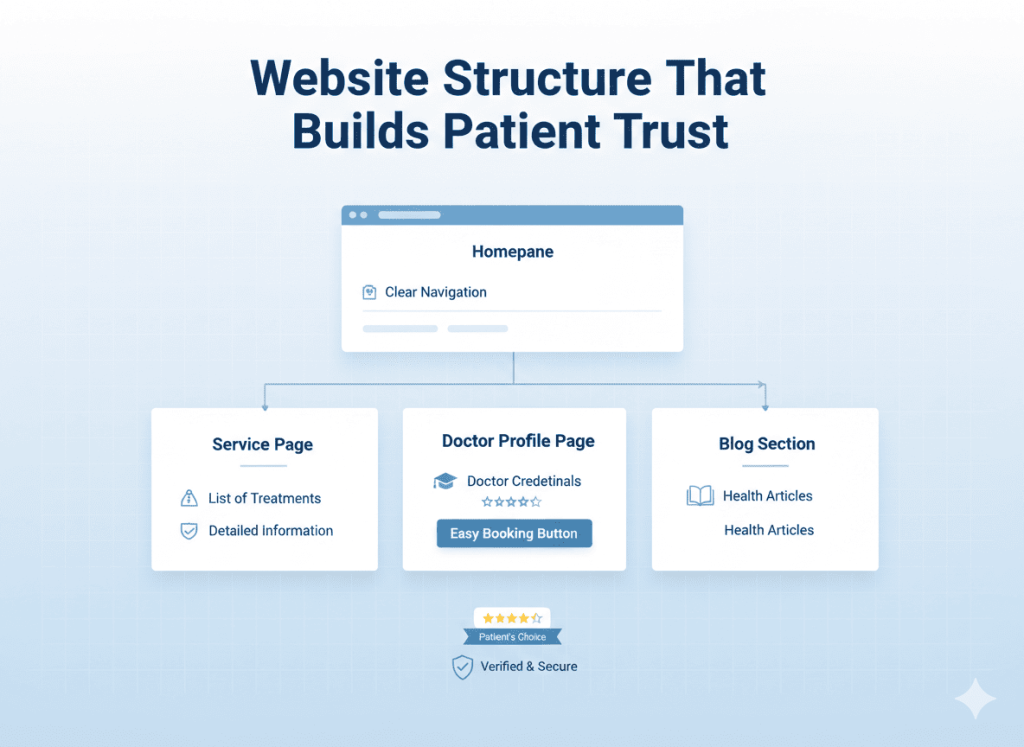
A well-structured healthcare website usually includes:
Homepage that speaks to patient needs
Your homepage should make visitors feel understood. It should explain:
- What conditions do you treat
- Where are located
- How to contact you
- Why do people trust you
Service pages that explain outcomes and expectations
For example, a page on laser eye treatments should answer:
- What the treatment involves
- Who it helps
- What results are expected
- Risks and safety points
- How to prepare
Patients do not want medical jargon. They want clarity.
Doctor profile pages that build confidence
Each doctor or specialist should have a profile that explains:
- Their background and credentials
- Years of experience
- Areas of specialty
- Languages spoken
- Personal philosophy of care
This helps humanize your clinic. Patients feel connected before they book.
Educational blog content that answers real questions
This is where SEO meets empathy. A blog that answers questions like:
- “How to manage migraine triggers.”
- “Is physiotherapy better than pain medication?”
- “When to see a dermatologist for acne scars.”
These articles bring people in early and build credibility over time.
Local SEO, The Heart of Clinic Visibility in the UAE
Healthcare is inherently local. A patient who searches “urgent care near Sharjah City Centre” is looking for physically close care.
To capture these local searches:
- Create location-based service pages
- Keep address, phone, and hours consistent across the web
- Optimize your Google Business Profile
- Encourage honest patient reviews
Reviews matter. They reinforce trust and influence rankings. A clinic with detailed reviews and responses feels active and patient-focused. That alone builds confidence.
Local SEO ensures you appear not just anywhere, but right where patients need you.
What Good Healthcare SEO Content Looks Like
SEO content does not mean keyword stuffing. Good content answers real questions in a real way.
Here’s what works:
- Use natural language that people actually search for
- Break up content into readable sections
- Add patient stories (with consent)
- Avoid exaggerated claims, be honest
- Use clear headings that reflect patient intent
For example, a page on “pediatric dental care in Dubai” should explain:
- How children’s dentistry differs from adult care
- What a parent can expect during the first visit
- How to prepare a child
- Sanitization and safety measures
- Contact and booking information
This is the kind of content that ranks and converts.
Technical SEO for Healthcare Websites
Technical SEO often sounds complex, but it simply means making the site accessible, fast, and easy to navigate.
Here’s what matters most for clinics:
Fast loading pages
Medical content must load quickly on phones and desktops. Patients don’t wait.
Mobile-friendly layout
Most healthcare searches happen on mobile. Your site must look clean and work smoothly.
Clear URL structure
Example:
/aesthetic-dermatology-dubai
This is clearer than a jumble of numbers and codes.
Secure and safe (HTTPS)
People trust secure sites mor, especially when they share contact information.
These elements make your content easier for search engines to understand and easier for patients to use.
Links and Authority in Healthcare SEO
In healthcare, authority is everything. Not in a marketing sense. In a human sense. People trust doctors with their bodies, not just their clicks. Search engines think the same way. A page can look perfect and still go nowhere if it does not feel credible.
Authority comes from real-world signals. When a clinic earns a mention in a local news article, it shows community relevance. When it appears in respected medical directories, it proves legitimacy. Partnerships with known health organizations add another layer of trust. Publishing evidence-based content, with clear references, shows responsibility and expertise.
Shortcuts never work here. Buying links might look tempting, but it damages trust. Patients can sense it. Search engines can too. Real authority builds slowly, through consistency and honesty. Once it is there, rankings improve naturally. More importantly, patients feel confident choosing your clinic.
Measuring What Actually Matters in Healthcare SEO
Healthcare SEO is not about traffic charts or inflated numbers. It is about outcomes that affect real people and real clinics. Vanity metrics do not fill appointment slots. Patient actions do.
Effective SEO leads to more appointment bookings. Its drives phone calls from people actively looking for care. It increases engagement on service pages where treatment decisions are made. keeps visitors reading educational content because they trust what they see. It strengthens local visibility for searches tied to urgent needs.
If someone searches for a physiotherapy clinic near Dubai Marina and then calls your clinic, that moment matters. That is not a theory. That is impact. Tracking these actions keeps SEO grounded in reality. It ensures your strategy supports patient care, clinic growth, and long-term trust.
Practical Mistakes Clinics Make, and How to Fix Them
Here are common missteps I see often, and what to do instead:
1. Mistake: Writing generic content that looks like every other clinic
Fix: Write in a human voice. Address specific patient concerns. Use real examples and context.
2. Mistake: Ignoring local search behavior
Fix: Create pages based on neighborhoods and communities, not just city names.
3. Mistake: Hiding doctor info behind generic bios
Fix: Create detailed profiles that reflect experience, personality, and care philosophy.
4. Mistake: Treating SEO as a one-time task
Fix: SEO is ongoing. You update content, track performance, and respond to trends.
Avoiding these mistakes elevates your clinic’s online presence in a crowded market like the UAE.
A Real Example: How SEO Helped a Medical Clinic in Dubai
A family clinic in Dubai relied mainly on referrals. They rarely updated their website and had little online visibility. They offered excellent care but very few online inquiries.
After focusing on clinic SEO in the UAE, they began:
- Publishing clear service pages for family medicine, pediatrics, and women’s health
- Writing educational articles based on real patient questions
- Optimizing for local keywords like “family doctor in Motor City.”
- Responding professionally to patient reviews
Within five months, they started ranking on page one for key terms. Appointment requests from organic search doubled. Patients found them early in the decision process, long before referrals.
This is how SEO becomes a growth engine, not just a checklist.
The Role of Newton Byte in Healthcare SEO
Healthcare SEO requires both strategy and sensitivity. You cannot treat medical SEO like generic marketing. You must understand patient psychology, local search behavior, and healthcare intent.
Newton Byte has helped clinics in the UAE grow with a patient-focused SEO approach. We don’t just aim for rankings. We aim for clarity, trust, and measurable growth.
If you want SEO that feels human and converts patients, working with a team that understands both search and patient needs makes a difference.
Frequently Asked Questions
Early SEO improvements appear within about three to five months. Significant rankings and consistent organic patient inquiries usually show up after six to nine months of steady work.
Clinics should do both. Educational content builds trust and attracts patients early, while service pages help convert those ready to book. Together, they create depth and relevance.
Yes. Honest patient reviews improve local visibility and credibility. They help Google understand relevance and help patients feel confident before booking.
Yes. Small clinics win by focusing on specific treatments, local search terms, and highly relevant content. Specialized pages often outrank broad hospital content.
Yes. Targeting both languages increases reach. It makes your clinic visible to both expatriates and local Arabic-speaking patients. Balance is key.