


Quick Answer
| Remarketing shows ads to people who already visited a website, watched a video, or engaged with a brand, instead of showing the same generic ad to a total stranger. In the UAE, where decision cycles are often long and competition is high, remarketing usually converts at a lower cost than any other part of an account. It works through five main formats: standard, dynamic, RLSA, video, and email-based remarketing, each suited to a different stage of the buying journey. |
Key Takeaways
- Remarketing shows ads only to people who already interacted with a business, not to strangers.
- There are five main remarketing formats: standard, dynamic, RLSA, video, and email-based (Customer Match).
- RLSA adjusts Search bids for returning visitors; it does not change the ad itself.
- Google requires a minimum list size before remarketing activates: roughly 100 users for Display, 1,000 for Search.
- Remarketing typically converts at a lower cost than cold traffic in the same Google Ads account.
- In the UAE specifically, long consideration cycles and heavy WhatsApp use make remarketing more valuable than in many other markets.
What Remarketing Actually Is
Remarketing, sometimes called retargeting, shows ads specifically to people who already interacted with a business. That could mean visiting a website, watching part of a video, or clicking a link.
Cold traffic has never heard of a brand before. Remarketing traffic already has. That single difference usually makes it the cheapest, highest-converting part of a Google Ads account.
Why Remarketing Matters More in the UAE Specifically
A few real patterns make remarketing especially valuable here, more than in many other markets.
- UAE buyers research extensively before committing. A luxury apartment, a high-end watch, or a B2B software contract rarely gets bought on the first visit.
- The market is mobile-first. A large majority of UAE ecommerce purchases happen on a phone, which means remarketing needs to work across devices someone actually uses, not just desktop.
- Competition drives CPCs up across almost every category. Warm remarketing traffic, already familiar with the brand, tends to convert at a noticeably lower cost than the same click bought cold.
- WhatsApp usage is extremely high across UAE consumers. A remarketing strategy that ignores WhatsApp interactions is ignoring a major part of how people actually communicate with local businesses.
- Many UAE households include multiple nationalities and languages under one roof. The same product page might get researched in English by one family member, then discussed in Arabic with another. Remarketing creative that only speaks one language misses half that conversation.
Remarketing Across Devices
A UAE shopper rarely completes a journey on one single device. Someone might browse a product on their phone during a commute, then finish the purchase later on a laptop at home.
Cross-device remarketing, when set up correctly, recognizes that it’s the same person, not two separate visitors. Signed-in Google accounts make this possible. Without it, a business risks showing the same cold-traffic ad twice to someone who already looked closely once, just on a different screen.
The Five Types of Remarketing, Compared
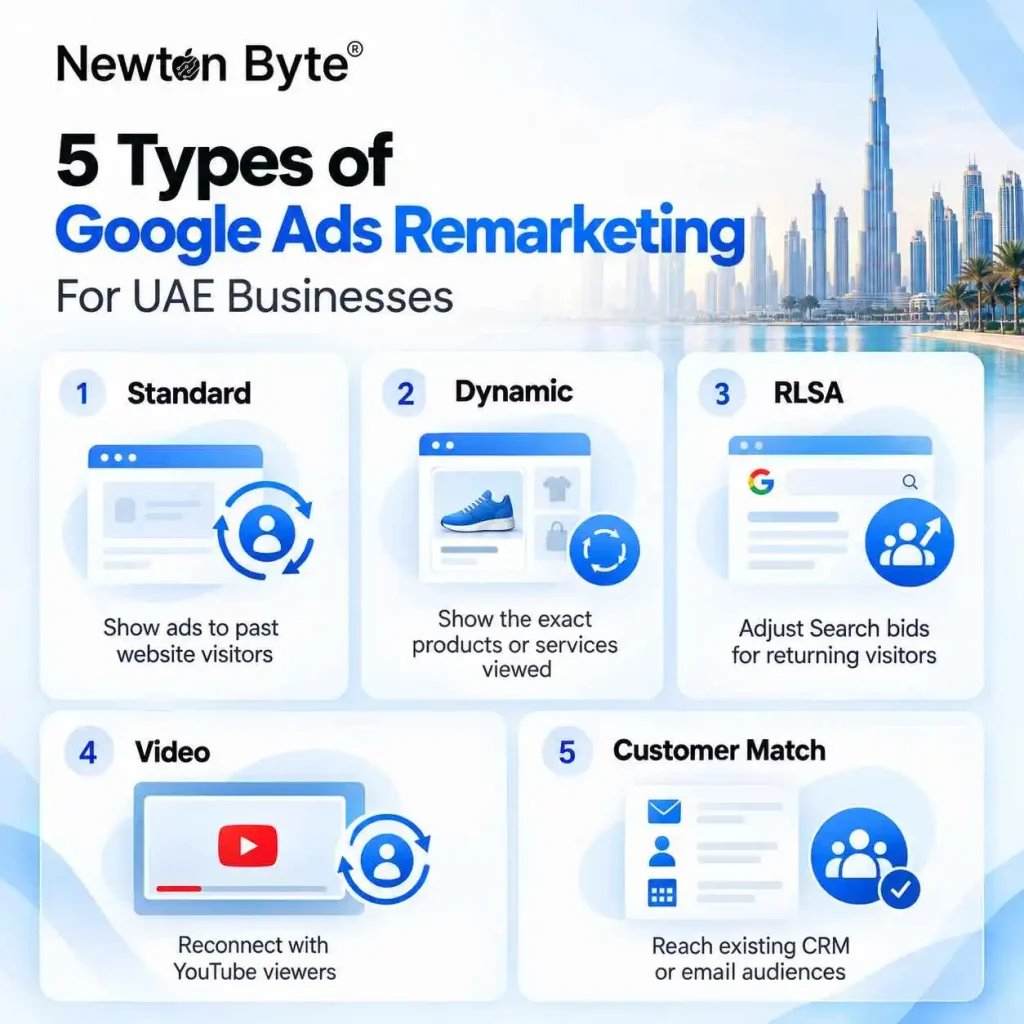
| Type | What It Does | Best Used For |
| Standard | Shows display ads to past website visitors as they browse other sites and apps. | General brand recall across the web. |
| Dynamic | Shows the exact product or service a visitor already looked at, not a generic ad. | Ecommerce and product-specific follow-up. |
| RLSA | Adjusts Search bids when a past visitor searches again. Does not change the ad itself. | High-consideration service businesses. |
| Video | Targets people who watched a video or engaged with a YouTube channel. | Awareness-to-conversion follow-up. |
| Email (Customer Match) | Uses an uploaded contact list to show ads to people already in a CRM. | Cross-sell and win-back campaigns. |
RLSA in Depth: The Format Most UAE Guides Undersell
RLSA deserves more attention than it usually gets. It’s not a separate ad. It’s a bidding layer sitting on top of an existing Search campaign.
Here’s a simple example. A Dubai accounting firm runs Search ads for “accounting services Dubai” at a certain cost per click. Someone visits the site, doesn’t convert, and a week later searches the same term again. RLSA lets that firm bid more aggressively for that specific searcher. A returning visitor searching the same category is worth more than an unknown one typing the identical words.
This format works best for service businesses with a genuine consideration period. Legal firms, medical clinics, financial advisors, and real estate agencies all fit this pattern well, since their customers rarely decide in a single search session.
How a Remarketing List Actually Gets Built
A remarketing list needs a minimum number of people before Google will use it. Roughly 100 users for a Display remarketing list, and 1,000 for a Search remarketing list. A brand-new UAE website usually needs a few weeks of real traffic before either list becomes usable.
List membership also has a duration. A visitor might stay on a list for 30 days, 90 days, or longer, depending on how the list is configured. A 30-day cart-abandonment list makes sense for a fast-decision product. A 90-day or longer list fits a slower purchase, like furniture, real estate, or a B2B service.
Frequency Capping: Why Showing an Ad More Often Isn’t Better
It’s tempting to assume more exposure always helps. It doesn’t.
Frequency capping limits how many times one person sees the same ad in a given period. Without it, a remarketing campaign can quietly show the same banner to the same person twenty or thirty times in a week. That burns budget on fatigue instead of new interest.
A reasonable cap keeps a brand visible without becoming background noise. Check it against how the campaign actually performs, and adjust from there.
UAE-Specific Remarketing Audiences Worth Building
- All website visitors from the last 30 days, a broad, general-purpose starting audience.
- Visitors who viewed a specific product or service page, useful for more targeted dynamic remarketing.
- People who added a product to cart but didn’t purchase, one of the highest-intent audiences available.
- People who clicked a WhatsApp button but never sent a message, a genuinely UAE-relevant audience most Display strategies skip entirely.
- Existing customers uploaded from a CRM, for cross-sell or renewal messaging rather than acquiring a brand-new customer.
Creative That Actually Works for UAE Remarketing Audiences
A remarketing ad shouldn’t repeat the exact same message a visitor already saw once and ignored.
- Scarcity and social proof cues tend to perform well with UAE audiences, phrasing like limited stock remaining or a visible customer count.
- A slightly different offer or angle from the first exposure gives a returning visitor a genuine reason to look again.
- Bilingual creative still matters here. A remarketing audience built from an Arabic-language storefront needs Arabic-language remarketing creative, not a repurposed English banner.
How to Measure Whether Remarketing Is Actually Working
The comparison that matters most is remarketing performance against cold-traffic performance in the same account, not remarketing judged in isolation.
- Click-through rate on remarketing ads is normally higher than on cold Display ads, since the audience already knows the brand. If it isn’t, the creative or the audience list likely needs attention.
- Cost per conversion on remarketing should sit meaningfully below the account’s cold-traffic average. If it doesn’t, frequency capping or list segmentation is usually the first thing to check.
- View-through conversions are easy to miss in a basic report. Someone sees a Display ad but converts later without ever clicking it. That’s still real influence, and Google Ads can attribute it if tracking is set up to catch it.
- List size over time shows whether remarketing has room to grow or is shrinking as membership durations expire faster than new visitors arrive.
Realistic Budget Guidance for UAE Remarketing
Remarketing rarely needs its own large, separate budget. It usually performs best as a modest, consistent spend running alongside Search and Shopping, not as a competing priority for the same money.
A reasonable starting approach sets aside a smaller share of the total account budget for remarketing. Increase it once cost-per-conversion data confirms it’s meaningfully outperforming cold traffic. Cutting remarketing budget to fund more cold-traffic spend is a common mistake. It often raises the account’s blended cost per conversion rather than lowering it.
Layering RLSA With Audience Lists
RLSA becomes more powerful once it’s combined with more specific audience segments, not just “anyone who visited the site.”
- Layer RLSA with a cart-abandonment list to bid more aggressively specifically on people who got close to buying.
- Layer RLSA with a high-value page visitor list, someone who viewed a premium service or product tier. Treat that return search as worth even more.
- Exclude converted customers from certain RLSA layers where a repeat purchase isn’t the immediate goal, so budget doesn’t chase people who’ve already bought.
This layering is where RLSA moves from a blunt bid adjustment to a genuinely precise tool. Different returning visitors get treated differently, instead of one flat rule applied to everyone who’s ever visited.
Privacy and Consent: What’s Changed Recently
Remarketing depends on tracking, and tracking rules have tightened. Consent Mode v2 affects how conversion and remarketing data get measured for users who haven’t given tracking consent.
Accounts that haven’t updated their tag setup for this are quietly losing remarketing list volume without realizing it. Checking that consent signals are properly configured is worth doing before assuming a remarketing list “should” be bigger than it currently is.
Common Mistakes UAE Businesses Make With Remarketing
- Skipping RLSA entirely and only running standard Display remarketing, missing a format built specifically for high-consideration service businesses.
- Never setting a frequency cap, and quietly burning budget on the same handful of people seeing the same ad far too often.
- Building only one broad remarketing list instead of separate lists for different behaviours, a cart-abandoner and a homepage-only visitor are not the same audience.
- Ignoring WhatsApp interactions completely, despite how central WhatsApp is to how UAE customers actually communicate.
- Reusing the exact same creative a visitor already saw and ignored once, instead of showing a different angle the second time.
How Newton Byte Approaches Remarketing for UAE Clients
Newton Byte builds remarketing as a layered system, not a single leftover campaign. RLSA sits on top of Search for consideration-heavy businesses. Dynamic remarketing runs for ecommerce and property listings. WhatsApp-click audiences get their own list, not a generic catch-all. For the full managed service, see Conversion Tracking UAE, since accurate tracking is what every remarketing list is actually built on.
Remarketing for B2B UAE Businesses
B2B remarketing works differently from ecommerce. There’s no product page to show back to a visitor, so the approach shifts toward content and proof.
- LinkedIn remarketing reaches UAE professionals in a work context, useful for HR software, consultancies, and corporate training providers.
- RLSA still applies strongly here, since a B2B buyer often researches over days or weeks before a decision gets made.
- Case studies and proof-focused creative tend to outperform generic brand messaging for a returning B2B visitor who’s already past the awareness stage.
Frequently Asked Questions
Nothing meaningful. Google generally calls it remarketing, and most of the wider industry calls the same concept retargeting. Both describe showing ads to people who already interacted with a brand.
It depends on the purchase cycle. A fast-decision product might only need a 30-day list. A slower purchase, real estate, furniture, or a B2B service, often performs better with a 90-day or longer window.
Often yes, since RLSA only adjusts bids on an existing Search campaign rather than requiring separate creative or a new budget line. It’s one of the more cost-efficient formats to add first.
There’s no universal number, but an uncapped campaign risks showing the same ad far too often to the same small group. A deliberate frequency cap, checked against actual performance, avoids that fatigue.
Not immediately. Google requires a minimum list size, roughly 100 users for Display and 1,000 for Search remarketing, before a list activates. A brand-new site usually needs a few weeks of traffic first.
It works well for both, just differently. Ecommerce benefits most from dynamic remarketing showing exact products. Service businesses, especially high-consideration ones, benefit most from RLSA and standard remarketing.
Given how central WhatsApp is to how UAE customers communicate with local businesses, yes. Someone who clicked through to WhatsApp but never sent a message is a real, warm audience most competitors ignore.
Conclusion: Remarketing Is Where an Account’s Cheapest Conversions Usually Live
Remarketing works because it stops treating every visitor like a stranger. Someone who already looked at a product, watched a video, or clicked through to WhatsApp has told a business something real about their intent, and ignoring that signal means paying full price for attention that’s already been earned once.
In the UAE specifically, long consideration cycles, heavy mobile and WhatsApp use, and genuinely high competition all point the same direction. Five formats, standard, dynamic, RLSA, video, and email-based remarketing, cover almost every situation a UAE business will run into. RLSA in particular remains underused by most competitors, despite being one of the more cost-efficient formats to add to an existing Search campaign.
Done properly, with the right list sizes, sensible frequency capping, and creative that respects both language and device habits, remarketing tends to become the best-performing, lowest-cost part of the whole account. That’s a reasonable place to start if only one part of a Google Ads account can be improved this month.