


Quick Answer
| Google Search Ads show text ads above Google’s organic results when someone in the UAE searches for a matching product or service. Getting them right in this market means tightly themed ad groups built around real search intent, a current match-type strategy (only three match types remain active as of 2026), separate handling for Arabic and English queries, and a negative-keyword list built for how UAE audiences actually search, not a generic global template. |
What Are Google Search Ads
Google Search Ads are text-based advertisements that appear above and below Google’s organic search results when someone searches for a matching term. Unlike Display or YouTube ads, Search Ads only reach people who are actively typing what they want into Google.
That distinction matters more in the UAE than in most markets. The UAE runs one of the most competitive Search auctions in the world, and an ad that doesn’t match the exact intent behind a query wastes budget faster here than almost anywhere else.
Why Search Ads Behave Differently in the UAE Market
Global Search Ads guidance rarely accounts for how UAE audiences actually search. A few patterns are worth understanding before building a campaign.
- Bilingual search volume: a meaningful share of commercial searches in the UAE happen in Arabic, not English. A campaign built only in English is competing for a smaller pool of demand than actually exists.
- Nationality- and community-specific queries: searches like “Indian lawyer Dubai” or “Filipino dentist Sharjah” reflect the UAE’s expat-heavy population. And ignoring this pattern means missing a real, searchable segment.
- Ramadan-driven shifts: search volume and intent both change noticeably during Ramadan. A campaign built once and left untouched through the year underperforms during this window.
- A Sunday-to-Thursday work week: ad scheduling built on a Monday-to-Friday assumption wastes budget. On the wrong days for much of the UAE’s B2B and service-based search activity.
- Emirate-level behaviour differences: mobile usage tends to be heavier in emirates like Sharjah, while desktop usage often spikes in Dubai during business hours. The same keyword can need a different bid and even a different ad by location.
How to Structure a Search Campaign for the UAE
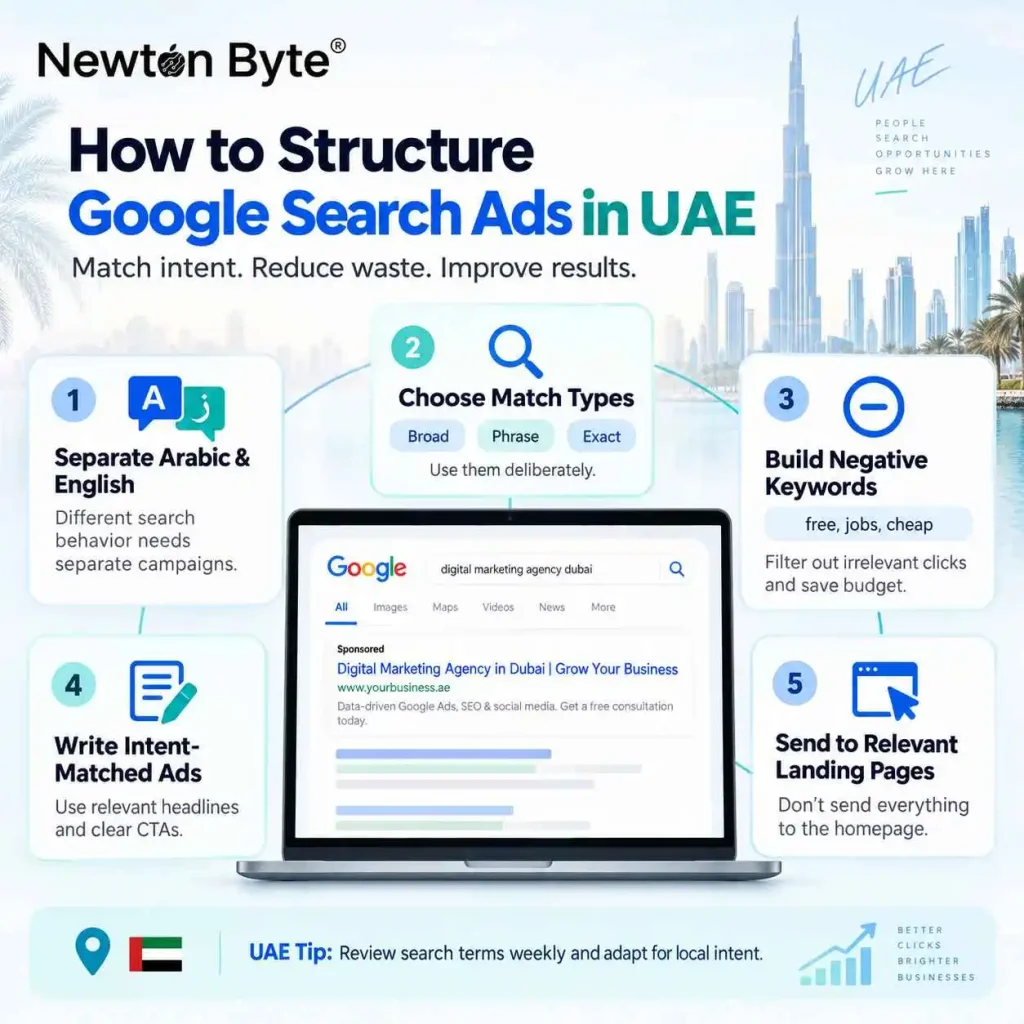
Build ad groups around a single, specific intent, not a broad topic. An ad group covering forty loosely related keywords forces one ad to try to speak to all of them, which usually means it speaks to none of them well. Every keyword in a group should be close enough in meaning that a single, tightly written ad actually fits all of them.
Choose Match Types Deliberately
As of 2026, Google Ads runs three active keyword match types: broad, phrase, and exact. Broad match modifier was retired some years ago and folded into phrase match, so any guide still describing four separate match types is out of date.
- Broad match now relies heavily on Google’s own AI to interpret intent, and performs best paired with Smart Bidding and enough conversion history for the algorithm to learn from, not as a standalone strategy for a brand-new UAE account.
- Phrase match is the most practical starting point for most new UAE campaigns: enough reach to gather real data, enough control to avoid the worst of the waste broad match can cause before an account has conversion history.
- Exact match stays the tightest option, best used on the highest-intent, best-converting terms once they’ve actually been identified in a UAE account’s own search-term data.
Build a UAE-Specific Negative Keyword List From Day One
Certain terms drain budget in almost every UAE Search account before a negative keyword list gets added. Adding these before launch, not after the first invoice, protects a new campaign’s budget from day one:
- free, cheap, jobs, career, salary, internship
- how to, DIY, template, course (unless the business actually sells one)
This starting list isn’t exhaustive. It gets refined weekly against the account’s own real search-term report, which is where most of a negative-keyword list should come from over time, not a generic template alone.
Writing Ad Copy That Actually Performs
Google’s own current guidance for Responsive Search Ads recommends at least one ad per ad group rated “Good” or “Excellent” for Ad Strength. In practice, that means:
- Multiple truly distinct headlines, not the same idea rephrased ten times
- At least one headline that includes the actual keyword being targeted
- A clear, specific call to action rather than a generic “learn more”
- A real point of difference from what a UAE searcher will see in competing ads for the same term
What Quality Score Actually Measures
Quality Score is Google’s estimate, on a scale of 1 to 10, of how relevant a keyword’s ads and landing page are to the person searching. It’s built from three components: expected click-through rate, ad relevance, and landing page experience. A higher score doesn’t just look better, it can mean paying less for the same ad position, since Google is rewarding relevance rather than bid size alone.
What Changed for Search Ads in 2026
- Consent Mode v2 affects how conversion data is measured for users in regions with consent requirements, and accounts that haven’t updated their tag setup are likely undercounting real conversions.
- Enhanced Conversions have moved toward a more unified setup across web and lead-generation conversions, which changes how offline and CRM-based outcomes should be fed back into an account.
- Search ads are increasingly appearing inside Google’s AI Overview placements, which changes how ad copy and landing pages should be evaluated, since the surrounding context a searcher sees is no longer only a list of blue links.
Common Mistakes UAE Businesses Make With Search Ads
- Using broad match without Smart Bidding on a brand-new account, which tends to waste budget quickly in a market this competitive.
- Running English-only campaigns and missing a real, searchable share of Arabic-language demand.
- Sending every ad to the same generic homepage instead of a page that matches the specific keyword’s intent.
- Building the negative-keyword list once at launch and never revisiting the account’s actual search-term report afterward.
- Ignoring Ramadan and other seasonal shifts, then judging full-year performance against a campaign that was never adjusted for them.
Frequently Asked Questions
Three active match types: broad, phrase, and exact. Broad match modifier was retired and folded into phrase match, so any resource still listing four separate match types is describing an outdated setup.
Neither extreme works well for a brand-new account. Phrase match is usually the more practical starting point, since it gathers enough real search data to work with while avoiding the heaviest waste broad match can cause before Smart Bidding has conversion history to learn from.
Yes. Search intent and phrasing genuinely differ between the two languages, and a single translated campaign rarely serves both audiences well. Separate keyword research and separate ad copy, not just a translated version of the English campaign, produces better results.
Quality Score is reported on a 1 to 10 scale. Anything at 5 or below is generally worth investigating, since it usually points to a mismatch between the keyword, the ad copy, or the landing page, and fixing that mismatch tends to lower cost per click as much as adjusting the bid does.
Weekly is the realistic standard for an actively managed account. Reviewing the search-term report on a set schedule, rather than only when performance drops, is what actually catches wasted spend before it adds up.
Related Reading