
Travellers today research and often book entire trips without ever speaking to a travel agent, unless the agency’s website gives them a reason to reach out instead. UAE travel and tourism agencies competing with global booking platforms need a website that does more than list packages. It needs to demonstrate local expertise, transparent pricing, and a booking experience that feels as easy as the major platforms travellers already use.
At Newton Byte, we’ve built websites for travel agencies across the UAE, and the ones that perform best are never trying to outbuild Booking.com. They’re focused on being unmistakably better at the specific things a big platform can’t personalize.
Here’s what a travel agency website in the UAE needs to convert research into real bookings.
Why Agencies Lose Bookings to Booking Platforms
Global platforms such as Booking.com and Expedia dominate generic travel searches, and agencies can’t outrank them for broad terms. What UAE travel agencies can win is trust and specificity: curated packages; local expertise in areas like Hajj and Umrah packages, regional tours, and visa assistance; plus personalized service that automated platforms don’t offer. A website that doesn’t clearly communicate this specialization looks like a weaker version of a booking platform instead of a genuinely different, better option.
Key Features Every Travel Agency Website Needs
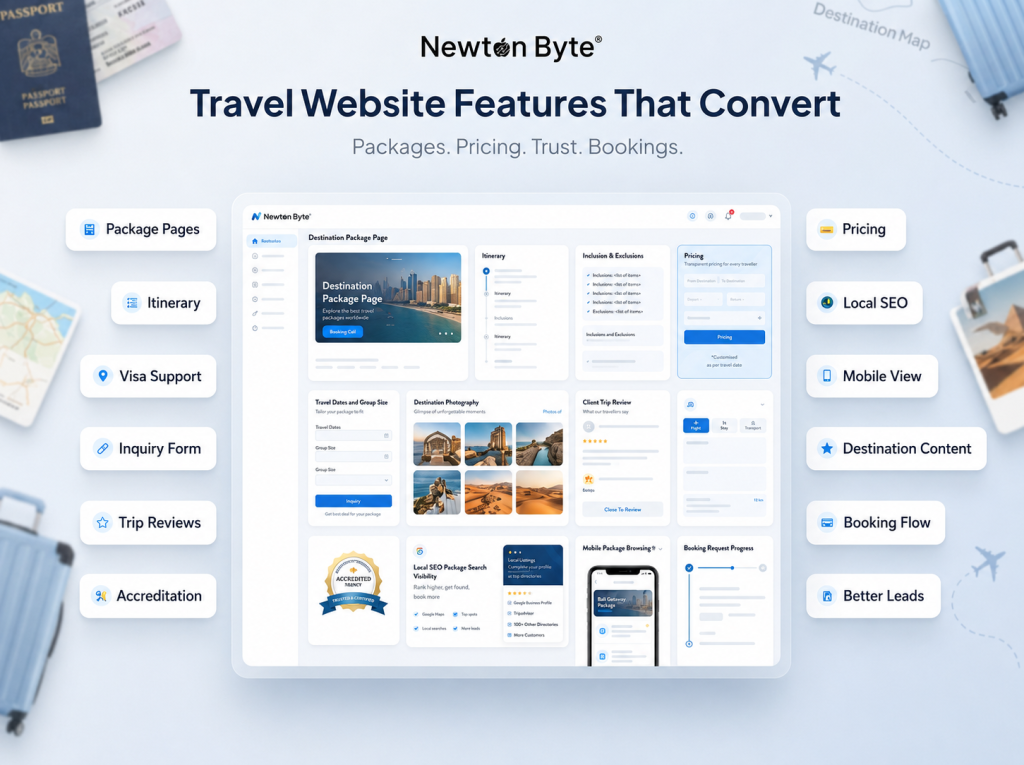
Curated package pages with real detail. Each tour or package should have its own page with itinerary, inclusions, pricing, and real photography, not a generic brochure PDF.
Visa and documentation support information. A major differentiator for UAE travel agencies is handling visa logistics. This should be clearly explained as part of the service, not left implied.
Transparent, itemized pricing. Travellers comparing agencies want to understand what’s included before inquiring. Being vague about starting-from pricing without detail creates hesitation.
Simple inquiry and booking process. A structured form capturing travel dates, group size, and destination speeds up agent response time and improves lead quality.
Trust signals specific to travel. IATA accreditation, years in operation, and genuine client trip reviews build confidence that’s especially important given the upfront payment travel bookings require.
The Complete Process: Building a Travel Agency Website That Converts
- Package and destination structuring. Organize offerings clearly by destination; trip type such as leisure, religious, or corporate; and package tier.
- Content and photography collection. Gather detailed itineraries and authentic destination photography rather than relying on generic stock travel imagery.
- Inquiry form design. Build structured forms that capture the details agents need to respond with a real, personalized quote quickly.
- Trust and credential display. Make IATA accreditation, years of operation, and specializations clearly visible, particularly on package and homepage content.
- Local SEO setup. Optimize for specific searches like Umrah packages from Dubai’ or ‘Maldives holiday packages UAE’, which carry far higher intent than broad travel terms.
- Mobile optimization. A significant share of travel research and inquiries happens on mobile, often during commutes or breaks.
Common Mistakes Travel Agencies Make
- Competing on broad, generic terms like cheap flights instead of specific, high-intent packages the agency actually specializes in.
- Vague package pricing that doesn’t clarify inclusions, leading to time-wasting inquiries and lost trust when the real price differs from expectations.
- No visible credentials or accreditation, which matters significantly for a service involving upfront payment for future travel.
- Weak or missing destination content, missing an opportunity to rank for research-stage searches before travellers are ready to book.
Related Reading for Business Owners:
| Planning a new business website involves more than choosing a design. Discover how businesses can win online in Ras Al Khaimah with strategies tailored to the local market; explore custom websites built to rank, convert, and grow your business to understand what drives long-term results; and compare hiring a web design agency versus a freelancer so you can choose the right partner for your business goals. |
Expert Insights and Best Practices
Specificity consistently outperforms breadth for travel agency websites. An agency with detailed, well-optimised pages for specific packages, such as a seven-day Maldives honeymoon package or a Ramadan Umrah package from Dubai, will typically generate more qualified inquiries than one with broad, generic destination pages, because these searches carry much clearer buying intent.
Trust signals matter more in travel than in most industries, since customers are paying in advance for a future experience. Agencies that clearly display accreditation, real client trip photos, and specific reviews build meaningfully more confidence than those relying on generic marketing language alone.
Cost and Business Impact
Travel and tourism agency websites in the UAE typically range from AED 7,000 for a clean, package-focused site to AED 25,000 or more for agencies needing booking engine integration or multi-currency, multilingual support. Agencies that shift from generic destination pages to detailed, specific package content typically see increased qualified inquiry volume without additional ad spend, since the content itself starts ranking for higher intent searches.
Why Choose Newton Byte for Your Travel Agency Website
Travel agencies need a website that competes on trust and specificity rather than trying to match global platforms feature for feature, and that positioning is exactly what we build toward at Newton Byte. We structure detailed package pages around your actual specializations, make visa assistance and accreditation visible where travellers expect to find them, and set up SEO around the specific, high-intent destinations and trip types you’re known for rather than broad travel terms you’ll never win. If your current site reads like a thinner version of a booking platform, we can show you what a more specific, trust-focused rebuild would look like.
Frequently Asked Questions
Not on broad, generic searches, but agencies win by targeting specific, high-intent packages and services such as visa assistance, curated group tours, and religious travel that automated platforms don’t personalize the same way. The goal isn’t to outrank the platforms everywhere; it’s to own the specific searches where your expertise genuinely matters.
Yes, as much as possible. Transparent, itemized pricing reduces time-wasting inquiries and builds trust with travellers comparing multiple agencies, especially since unclear pricing is one of the fastest ways to lose credibility with someone about to make a significant upfront payment.
Typically between AED 7,000 and AED 25,000, depending on booking engine integration, number of destinations covered, and design complexity. Agencies needing multi-currency support or a live booking engine tend to sit toward the higher end of that range.
This depends on the agency’s business model. Agencies selling standardized packages benefit from a booking engine that lets customers complete a purchase directly, while those offering highly customized trips often perform better with detailed inquiry forms that allow for a more personal, tailored quote process.
Very important. Well-written destination guides capture travellers in the research phase, well before they are ready to book, building long-term organic traffic that goes beyond what package pages alone can generate.
Yes, prominently. This is one of the strongest trust signals available to a travel agency, particularly for customers unfamiliar with the brand who need reassurance before committing to an upfront payment for future travel.
For agencies serving diverse client bases, offering content in Arabic and English, and potentially other relevant languages depending on your typical client demographics, can meaningfully expand reach and trust with travellers who prefer researching in their own language.
Listing vague starting-from prices without clarifying what is and isn’t included, which leads to mismatched expectations and lost trust during the inquiry process when the real quote turns out to be significantly different from what the traveller expected.
Final Thoughts
A travel agency’s website needs to do what global booking platforms can’t: demonstrate genuine local expertise and build enough trust that a traveller chooses a personal agency over a faceless platform. If your current site reads like a weaker version of a booking site, you’re likely losing bookings you’re actually positioned to win.
Need a travel agency website that converts research into real bookings? Get in touch with Newton Byte for a free consultation.