
Legal clients rarely choose a law firm impulsively. Before reaching out, they research credentials, practice areas, case experience, and reputation, almost entirely through the firm’s website. If that website looks generic, outdated, or unclear about what the firm actually specializes in, prospective clients quietly move on to a competitor that looks more established, regardless of actual expertise.
At Newton Byte, we’ve built websites for several UAE law firms, and the same lesson comes up every time: clients decide whether to call within the first few seconds on a practice area page, based almost entirely on how clearly and credibly it’s written.
Here’s what a law firm website in Dubai needs to convert research into real client inquiries.
Why Credibility Is the Deciding Factor
Legal services fall into a high trust content category, similar to healthcare and finance. Clients and search engines evaluate law firm websites heavily on demonstrated expertise and authority, not just design polish. A firm with vague practice area descriptions and no visible lawyer credentials struggles to build trust, no matter how experienced the actual team is.
What legal clients specifically look for before contacting a firm:
- Clear practice areas with real explanation, not just a list of legal terms
- Lawyer profiles with qualifications, bar admissions, and case experience
- Firm history and notable achievements or recognitions
- Straightforward ways to request a consultation
- Language options, particularly Arabic and English, given Dubai’s client base
Key Features Every Law Firm Website Needs
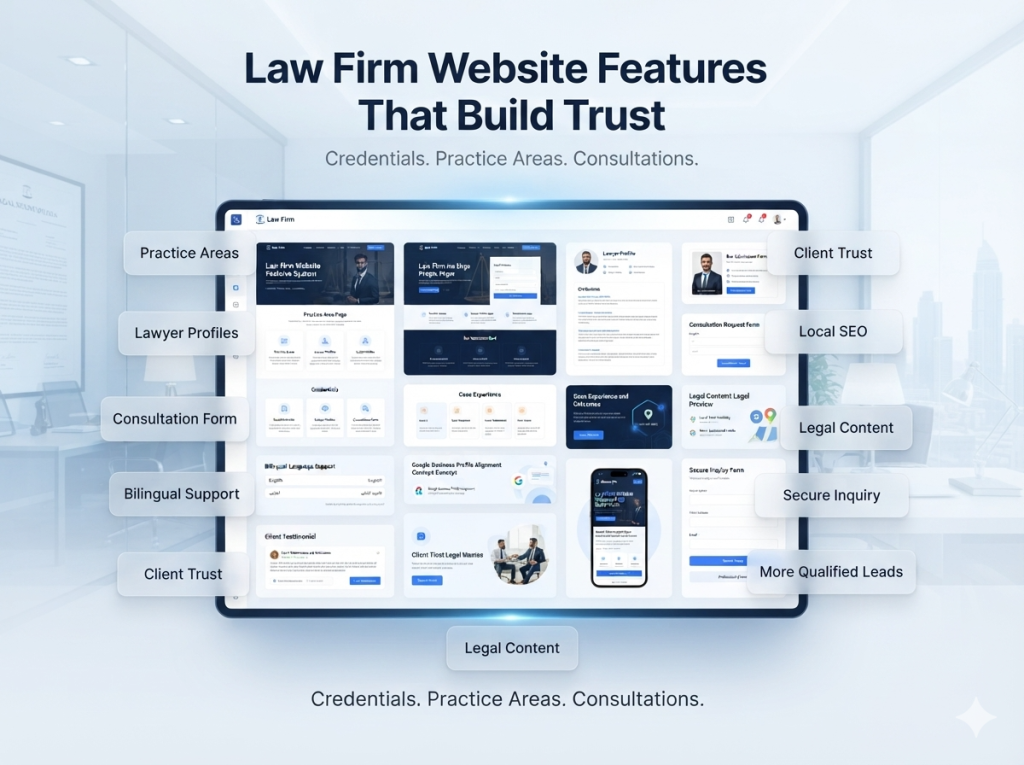
Detailed practice area pages. Each area, whether corporate law, family law, litigation, or real estate law, deserves its own page explaining what it covers, common client situations, and how the firm approaches it. A single generic practice areas page undersells the firm’s depth.
Lawyer profile pages. Individual attorney pages with qualifications, years of experience, notable cases where confidentiality allows, and areas of focus significantly increase client confidence before first contact.
Clear consultation request process. A simple, low-friction form or WhatsApp option, not a generic contact us page requiring clients to figure out who to reach.
Multilingual support. Arabic and English bilingual websites are a meaningful trust signal and functional necessity for firms serving Dubai’s diverse client base.
Case results or client outcomes, presented carefully and within legal advertising regulations, to demonstrate real capability.
The Complete Process: Building a Law Firm Website in Dubai
- Practice area content planning. Map every service the firm offers into distinct, well-researched pages rather than one combined overview.
- Lawyer content collection. Gather accurate credentials, bar admissions, and professional photography early. This content typically takes the longest to finalize.
- Compliance review. Confirm content aligns with UAE legal advertising regulations before publishing, particularly around claims of results or specializations.
- Bilingual structure. Build the site architecture to properly support Arabic and English from the start, rather than retrofitting translation later.
- Trust-focused design. Use a clean, professional visual style. Legal clients respond negatively to overly casual or trend-driven design choices.
- Local SEO setup. Optimize for practice area and location-specific searches, and ensure consistent contact details across Google Business Profile and directories.
Common Mistakes Law Firms Make
- Combining all practice areas into one vague page, making it hard for potential clients to confirm the firm handles their specific issue.
- Missing or incomplete lawyer credentials, which directly undermines trust for a decision this significant.
- No clear next step after a client reads a practice area page, leaving them unsure how to proceed.
- Ignoring mobile experience, despite many potential clients researching legal help urgently from their phones.
| Helpful Resources: How to Choose the Right Web Design Agency in Dubai: Learn what to look for before hiring a web design company and avoid costly mistakes. Hiring a Web Design Agency Versus a Freelancer: Compare both options to find the right fit for your business, budget, and long-term goals.When to Redesign Your Website Without Losing Your Rankings: Discover the best time to redesign your website while protecting your existing SEO performance. |
Expert Insights and Best Practices
Detailed, well-written practice area content consistently outperforms shorter, generic pages both in search rankings and client trust. Search evaluation of legal content increasingly favors firms that demonstrate real expertise through substantive explanation rather than keyword-focused summaries.
Client testimonials and case outcomes, presented within appropriate legal advertising guidelines, are among the strongest trust signals a law firm website can offer, since prospective clients are specifically looking for evidence the firm can handle situations similar to their own.
Cost and Business Impact
Law firm websites in the UAE typically range from AED 10,000 for a clean, professional site covering core practice areas to AED 30,000 or more for larger firms needing multiple lawyer profiles, bilingual content, and custom design. Firms that invest in detailed practice area content and clear consultation pathways typically see a meaningful increase in qualified inquiry volume, since the website does more of the trust-building work before the first conversation.
Why Choose Newton Byte for Your Law Firm Website
Legal websites need a level of care that goes beyond visual design, and that’s the part we focus on most at Newton Byte. We structure practice area pages so each one genuinely explains what the firm does and who it’s for; we build lawyer profile pages that highlight the credentials clients are actually looking for, and we keep the design professional and restrained in a way that suits how legal clients expect a firm to present itself. We also review content structure against general UAE legal advertising conventions as we build, though we’d always recommend a final compliance check from your own legal advisor before publishing. If your current site groups everything into one vague page or buries your lawyers’ credentials, we can walk through it with you and show you what a clearer structure looks like.
Frequently Asked Questions
Yes, legal marketing in the UAE is subject to regulatory guidelines regarding claims, case results, and professional conduct. These rules affect what can be said about outcomes, how experience can be described, and in some cases, how consultations can be advertised, so it’s worth having legal counsel review the final website content against current regulations before it goes live.
For firms with more than a few attorneys, yes. Individual profiles significantly improve both client trust and search visibility for lawyer-specific searches, since many potential clients search directly for a named lawyer they’ve been referred to, and a strong profile page gives that search somewhere useful to land.
Very important for firms serving a broad client base. Bilingual sites expand your reach to Arabic-speaking clients who prefer researching legal matters in their first language, and they signal a level of cultural and market fluency that adds to the firm’s overall credibility, particularly for practice areas like family or property law.
This depends heavily on local advertising regulations, which often restrict specific claims about outcomes or amounts. In most cases, general descriptions of case types successfully handled, without specific figures, are a safer and still effective way to demonstrate capability.
Long enough to genuinely answer a prospective client’s questions, which in practice usually works out to somewhere between 600 and 1,000 words per practice area. That’s enough space to cover what the service involves, the kinds of situations it typically applies to, and what a client should expect from working with the firm on that issue.
Yes, particularly for higher-stakes legal matters where the client is essentially choosing who to trust with something significant. Clients want to know the person they’re about to speak with is genuinely qualified and experienced in their specific type of case, not just a generalist.
This is ultimately a business decision for the firm, but whichever model is used should be stated clearly on the website. Ambiguity here creates friction at exactly the point where a potential client is deciding whether to reach out, so clarity matters more than which specific model you choose.
A simple, visible way to request a consultation directly from every practice area page, rather than funneling everyone back to a single generic contact page. Clients who’ve just read about a specific service want to act on that interest immediately, and making them hunt for a contact form loses a meaningful share of them.
Final Thoughts
A law firm’s website is often the first real interaction a potential client has with the firm, and it’s evaluated for credibility before a single conversation happens. If your current site is vague about practice areas or lawyer credentials, you’re likely losing well-qualified inquiries to firms that present themselves more clearly.
Need a law firm website built to earn client trust and generate real inquiries? Get in touch with Newton Byte for a free consultation.