



Choosing the right web development agency is an important decision for any business that wants to build a professional online presence. Your website is often the first place potential customers visit to learn about your services, explore your products, and decide whether your business meets their needs.
However, choosing an agency based only on attractive designs or low development costs can lead to problems later. You need a development partner who understands your business goals, technical requirements, target audience, and plans for future growth.
Different website development agencies offer different levels of expertise. Some specialize in website design services, while others provide complete solutions covering custom web development, responsive design, website performance, SEO, integrations, and ongoing maintenance.
At Newton Byte, we understand that a business website needs more than an attractive appearance. It should provide a clear user experience, support your business objectives, and give visitors a straightforward way to take action.
In this guide, we explain how to choose a web development agency, what to check before hiring one, and which questions to ask to make a confident decision.
Quick Answer
To understand how to choose a web development agency, start by defining your website goals, reviewing relevant portfolio work, checking technical expertise and SEO knowledge, comparing project scope and pricing, confirming website ownership, and evaluating post-launch support. The right agency should have relevant experience, a clear development process, transparent communication, and the ability to support your website after launch.
1. Define Your Website Requirements and Business Goals
Before contacting a web development agency, establish what you want your website to achieve. Clear requirements help agencies understand your expectations and recommend suitable development solutions.
For example, a small business may need a professional website to present its services and generate inquiries. An established company might require a custom website with customer portals, booking functionality, CRM integrations, or advanced content management features.
Start by identifying the following requirements:
- Website purpose: Do you need a business website, corporate website, portfolio, ecommerce store, or web application?
- Target audience: Who will visit your website, and what information or services will they expect?
- Required pages: Which pages do you need, such as Home, About Us, Services, Portfolio, Blog, and Contact?
- Website functionality: Will your website require contact forms, booking systems, user accounts, payment options, or third-party integrations?
- Design preferences: Do you need a custom design or a website based on an existing theme?
- Future requirements: Will you add new services, pages, features, or business locations later?
You should also identify the main action you want visitors to take. This could include requesting a quotation, booking a consultation, purchasing a product, or contacting your team.
A clear understanding of these requirements makes it easier to evaluate proposals and select an agency that can deliver the right solution.
2. Evaluate the Agency’s Web Development Experience
Not every agency has the same technical capabilities. Some focus primarily on website design, while others specialize in custom development, complex functionality, and business integrations.
Before hiring an agency, review its experience with the technologies and website types relevant to your project.
Look for experience in:
- WordPress website development.
- Custom website development.
- Ecommerce website development.
- Frontend and backend development.
- Website redesign and migration.
- Content management systems.
- API and third-party integrations.
- Responsive website development.
- Website speed and performance optimization.
You should also understand how the agency approaches development challenges.
For example, if your website requires a customer login system or integration with existing business software, ask whether the team has completed similar work before.
An experienced development team should be able to explain which technologies are suitable for your project and why. It should also identify potential limitations before development begins.
Do not choose an agency simply because it claims to work with every technology. Focus on relevant experience and the ability to deliver your specific requirements.
3. Review the Development Portfolio and Previous Projects
A development portfolio helps you evaluate an agency’s design quality, technical experience, and ability to complete different types of projects.
However, looking at screenshots is not enough. Visit the websites included in the portfolio and explore their actual functionality.
Pay attention to these important areas:
Website design and layout: Does the website look professional? Are the pages organized logically, with consistent typography, spacing, and visual elements?
Navigation and usability: Can visitors find important information without confusion? Are menus, buttons, and internal links easy to use?
Mobile responsiveness: Does the website display correctly on smartphones and tablets? Check how the navigation, images, forms, and content adjust to smaller screens.
Website functionality: Do contact forms, buttons, interactive elements, and other features work correctly?
Loading performance: Do pages load efficiently? Are images optimized, and does the website avoid unnecessary elements that affect performance?
Content presentation: Is the information easy to read? Are headings, paragraphs, and calls to action arranged clearly?
You should also ask the agency about its contribution to the projects shown in its portfolio. Find out whether it handled the complete website development process or only specific parts, such as design or frontend development.
This helps you understand the team’s actual responsibilities and experience.
4. Check the Website Design Services Offered by the Agency
A business website should combine visual quality with functionality. The design should help visitors understand your business, find relevant information, and complete important actions.
Before choosing an agency, check whether its website design services cover the following areas.
UI and UX design: The agency should create layouts that are visually consistent and easy to navigate. User experience should guide how visitors move between pages and interact with website features.
Responsive design: Your website should adapt to different screen sizes, including desktops, laptops, tablets, and smartphones.
Brand consistency: The design should reflect your brand identity through appropriate colors, typography, imagery, and visual elements.
Conversion-focused layouts: Important information and calls to action should be easy to find. Visitors should understand what your business offers and how to contact you.
Custom design requirements: If your business needs a unique layout or specific functionality, confirm whether the agency can create custom designs rather than relying entirely on pre-built templates.
A good design process should also include opportunities for you to review and approve the proposed layouts before development begins.
5. Understand the Website Development Process
A professional web development agency should follow a structured process from the initial discussion to the final website launch.
Understanding this process helps you evaluate how the agency manages projects and handles different development stages. If your project includes advanced functionality, integrations, portals, or application features, review the agency’s broader web and app development capabilities as well.
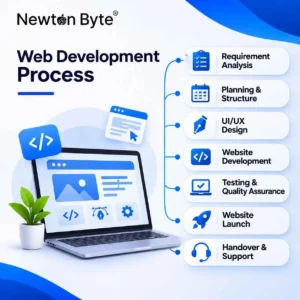
A typical website development process includes:
Step 1: Requirement Analysis
The agency discusses your business, target audience, website objectives, required pages, and technical requirements.
Step 2: Planning and Structure
The team prepares the website structure, navigation, page hierarchy, and development plan.
Step 3: UI/UX Design
Designers create page layouts and visual concepts based on your brand identity and user requirements.
Step 4: Website Development
Developers build the website, implement the approved designs, configure functionality, and integrate the required tools.
Step 5: Testing and Quality Assurance
The team checks website responsiveness, navigation, forms, links, functionality, browser compatibility, and performance.
Step 6: Website Launch
After testing and approval, the agency publishes the website and checks that its important features work correctly.
Step 7: Handover and Support
The agency provides the necessary access details, documentation, and agreed post-launch assistance.
Ask how the agency manages each stage and how often it shares progress updates. A clear process helps prevent confusion, unnecessary revisions, and delays.
6. Evaluate the Agency’s Technical SEO and Performance Knowledge
Website development and SEO should work together. A website may look professional, but technical problems can make it difficult for search engines to crawl, understand, and index its pages.
Choosing an agency that understands technical SEO helps establish a better foundation for your website.
Check whether the development team considers:
- SEO-friendly URL structures.
- Proper heading hierarchy.
- Editable title tags and meta descriptions.
- XML sitemap configuration.
- Robots.txt settings.
- Canonical tags.
- Image optimization and descriptive alt text.
- Mobile usability.
- Website loading performance.
- Core Web Vitals.
- Internal linking structure.
- Appropriate schema markup.
Website performance also matters to visitors. Large images, unnecessary scripts, poor hosting, and inefficient code can affect loading times and usability.
Ask the agency how it tests website performance and whether it checks important pages before launch. Google’s own Search documentation also recommends simple, descriptive, crawlable URL structures, so URL planning should be part of development rather than an afterthought: https://developers.google.com/search/docs/crawling-indexing/url-structure
You should also clarify whether ongoing SEO is included in the development package. Technical SEO setup and a complete SEO campaign are different services, so the proposal should explain what is covered.
7. Compare Website Development Costs and Project Scope
Website development costs vary depending on the complexity of the project, required functionality, design customization, technology, and development timeline.
A simple business website generally requires less work than a custom platform with multiple integrations and advanced features.
Instead of comparing quotations based only on their total prices, examine what each agency includes in its proposal.
Your project scope should clearly define:
- Number of website pages.
- Design and customization requirements.
- Content upload responsibilities.
- Required website functionality.
- Third-party integrations.
- Mobile responsiveness.
- Technical SEO setup.
- Testing and quality assurance.
- Number of revision rounds.
- Estimated delivery timeline.
- Website handover requirements.
- Post-launch support.
For example, one agency may include website design and development, content upload, and basic SEO setup. Another may quote only for development, leaving content entry, integrations, and testing as additional costs.
Request an itemized quotation so you understand what you are paying for.
Also, discuss how additional requirements will be handled if your needs change during development. A clear agreement helps avoid unexpected expenses and disagreements.
8. Assess Communication and Project Management
Communication plays an important role in the success of a website development project.
You will need to share information, review designs, provide feedback, approve pages, and make decisions throughout development. The agency should have a clear process for managing these activities.
Before hiring a web development agency, ask:
- Who will manage your project?
- Will you have a dedicated point of contact?
- How frequently will you receive progress updates?
- How will you review and approve designs?
- How will the team handle feedback and revisions?
- Which tools will the agency use to manage tasks?
- How will delays or technical problems be communicated?
Pay attention to how the agency responds during your initial discussions. Does it listen to your requirements and provide relevant recommendations, or does it immediately push a standard package?
A reliable agency should explain technical matters clearly, communicate potential challenges, and keep you informed about project progress.
9. Confirm Website Ownership, Security, and Maintenance
Your website is a business asset. Before signing an agreement, clarify who will own the website and its related accounts after development.
You should have appropriate access to your website, domain, hosting, content management system, and other relevant business accounts.
Discuss the following ownership and security requirements:
- Website administrator access.
- Domain and hosting account ownership.
- Website source code and design files, where applicable.
- Premium theme and plugin licensing.
- Database and website backup access.
- Third-party integration accounts.
- SSL certificate configuration.
- User permissions and access controls.
You should also ask how the agency handles website maintenance.
Websites require regular updates to keep their software, plugins, themes, and integrations working properly. Security monitoring, backups, bug fixes, and performance checks can help reduce technical problems.
Make sure the agency explains whether maintenance is included in the project or available through a separate support agreement.
10. Ask About Post-Launch Support
Website development does not end when the website goes live. Your business may need technical assistance, new features, content updates, or improvements after launch.
A professional agency should explain what support it provides once the project is completed.
Ask whether post-launch support includes:
- Fixing development-related bugs.
- Resolving website functionality issues.
- Updating plugins and website software.
- Managing backups and recovery.
- Troubleshooting forms and integrations.
- Monitoring website performance.
- Adding new pages or features.
- Providing technical guidance.
Also, confirm the duration of included support, response times, maintenance charges, and the process for requesting changes.
For example, if your contact form stops working after launch, you should know whom to contact and whether the issue falls under the agreed support terms.
Having these details in writing gives you a clearer understanding of the agency’s long-term responsibilities.
How to Choose a Web Development Agency: Quick Checklist
Use this checklist when comparing shortlisted agencies:
| Check | What to Confirm |
|---|---|
| Business requirements | Goals, target audience, pages, functionality, and future plans |
| Relevant experience | Technologies, website types, and similar projects |
| Portfolio | Live websites, usability, mobile responsiveness, and functionality |
| Design capability | UI/UX, responsive design, brand consistency, and custom design |
| Development process | Planning, design, development, testing, launch, and handover |
| Technical SEO | URLs, headings, metadata, sitemap, schema, mobile usability, and Core Web Vitals |
| Pricing and scope | Deliverables, revisions, timeline, integrations, and additional costs |
| Communication | Project manager, progress updates, approvals, and feedback process |
| Ownership and security | Domain, hosting, CMS, code, backups, SSL, and account access |
| Post-launch support | Bug fixes, maintenance, updates, monitoring, and future improvements |
Questions to Ask Before Hiring a Web Development Agency
Before making your final decision, ask shortlisted agencies a few important questions. Their answers can help you compare experience, services, project management, and technical capabilities.
- What types of websites have you developed? Look for experience relevant to your industry and project requirements.
- Can you share your development portfolio? Review completed websites and test their functionality.
- Which technologies and platforms do you use? Make sure the agency can work with the technology your project requires.
- What is included in your website development package? Request a clear list of deliverables.
- Do you provide custom website design services? Confirm whether the team can meet your branding and functionality requirements.
- How do you approach technical SEO and website performance? Look for a development process that considers search visibility and user experience.
- Who owns the website after completion? Confirm ownership and access to all important accounts.
- What post-launch support do you offer? Understand the maintenance arrangements and additional costs.
Do not rush the selection process. A few detailed discussions can help you identify an agency that understands your project and can deliver the expected results.
Why Choose Newton Byte for Web Development?
Choosing a web development partner means finding a team that understands your business objectives and can turn your requirements into a functional, professional website.
Newton Byte provides web development services and digital solutions for businesses that want to establish, improve, or expand their online presence.
Our services include:
- Business Website Development: Professional websites designed to present your services, communicate your brand, and generate business inquiries.
- Custom Website Development: Tailored development solutions for businesses with specific design and functionality requirements.
- WordPress Development: Flexible WordPress websites with manageable content and customizable features.
- Ecommerce Development: Online stores with product management, payment integrations, and essential shopping functionality.
- Website Redesign: Improvements to existing websites, including layouts, usability, responsiveness, and functionality.
- Website Maintenance: Technical updates, troubleshooting, and ongoing website support.
We focus on understanding project requirements before recommending a development approach. Our goal is to create websites that are easy to use, aligned with your brand, and built around your business needs.
Whether you need a new company website, a custom development solution, or a complete website redesign, Newton Byte can help you plan the right approach.
Frequently Asked Questions
1. What does a web development agency do?
A web development agency plans, designs, builds, tests, and maintains websites for businesses. Its services may include UI/UX design, frontend and backend development, CMS configuration, custom functionality, integrations, technical SEO, and website maintenance.
2. How do I choose the best web development agency for my business?
Start by defining your website requirements and business goals. Then review the agency’s development portfolio, technical expertise, previous projects, website design services, pricing, communication process, and post-launch support. Choose an agency that can meet your requirements and explain how it will deliver the project.
3. How much does it cost to hire a web development agency?
The cost depends on the website’s size, design complexity, functionality, technology, integrations, and development timeline. A basic business website usually requires less development work than a custom website or ecommerce platform. Request a detailed quotation based on your project scope.
4. What is the difference between web design and web development?
Web design focuses on the website’s appearance and user experience, including layouts, colors, typography, and navigation. Web development focuses on building the website’s functionality through frontend and backend technologies. Both work together to create a complete website.
5. What should I look for in a web development agency’s portfolio?
Check design quality, mobile responsiveness, navigation, functionality, loading performance, and the types of websites the agency has completed. Visit live projects instead of relying only on screenshots. Ask about the agency’s specific contribution to each project.
6. How long does it take to develop a business website?
A standard business website may take a few weeks, while a larger website with custom functionality, integrations, or complex design requirements may take several months. The timeline depends on the project scope, content availability, design approvals, and testing requirements.
7. Why is responsive website design important?
Responsive website design allows a website to adjust to different screen sizes and devices. It helps visitors access content, navigate pages, and interact with website features on smartphones, tablets, and desktop computers. It also supports mobile usability and search engine optimization.
8. Does a web development agency provide website maintenance after launch?
Many agencies offer ongoing maintenance through separate support agreements or service packages. These services may include software updates, backups, security checks, bug fixes, performance monitoring, and technical troubleshooting. Always confirm the support duration, responsibilities, and costs before signing an agreement.
Final Thoughts
Choosing the right web development agency requires careful evaluation of more than design quality and development costs. You need a team that understands your business, has relevant technical experience, follows a clear development process, and provides the support your website needs after launch.
If you are deciding how to choose a web development agency, focus on relevant experience, technical capability, transparent project scope, ownership, communication, and long-term support.
Review previous projects, compare website development agencies, define your project scope, and discuss ownership and maintenance before making your final decision. These steps can help you avoid unnecessary costs and build a website that supports your business objectives.
At Newton Byte, we help businesses develop professional websites based on their goals, audience, and technical requirements. Whether you need a business website, custom development, WordPress solutions, or a complete redesign, our team is ready to discuss your project.
Ready to build a website for your business? Contact Newton Byte to discuss your requirements and find the right web development solution for your goals.