
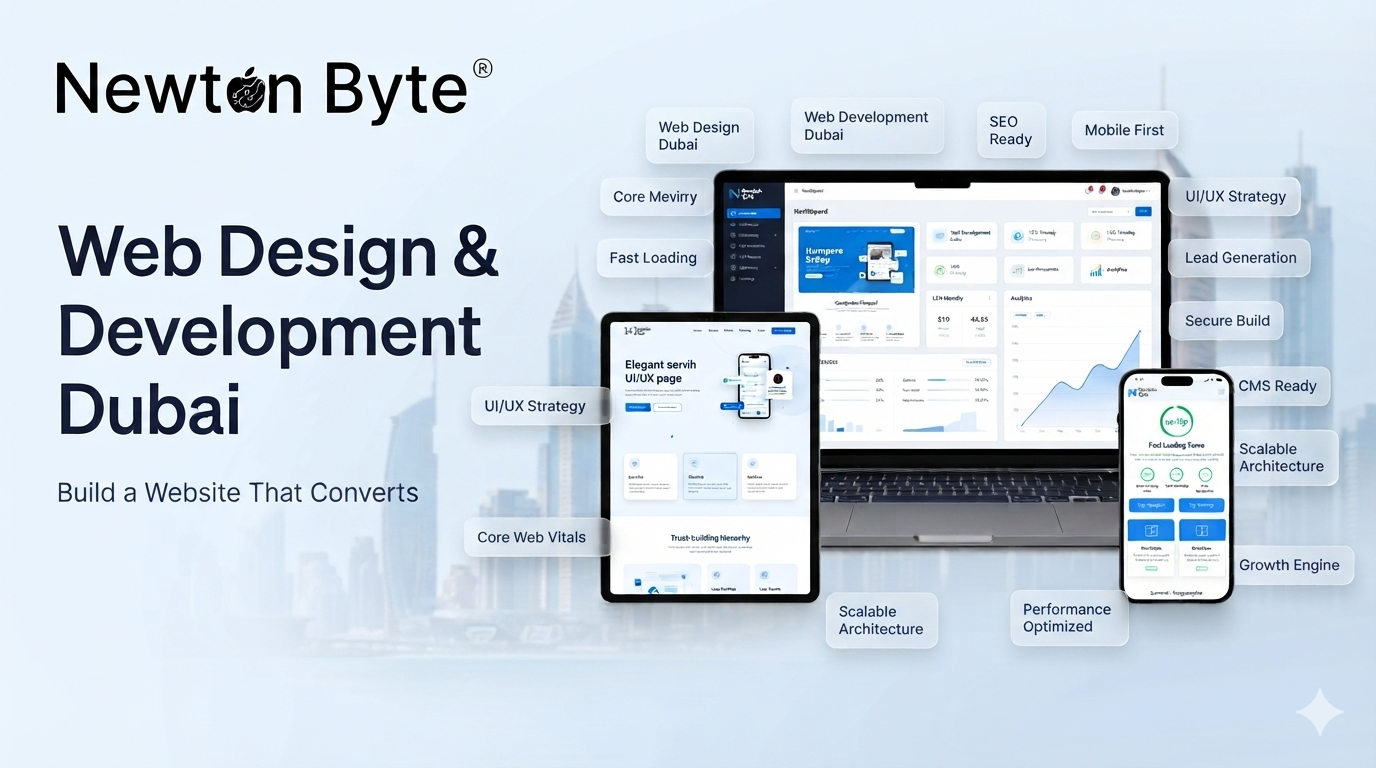
Dubai is home to hundreds of web design agencies. From Business Bay and Dubai Internet City to Sheikh Zayed Road, businesses have no shortage of options. Almost every agency promises a modern, fast, and visually impressive website. Yet many companies still end up with sites that look good on the surface but deliver very little. They struggle to rank on search engines, fail to generate leads, and often feel outdated within a year or two.
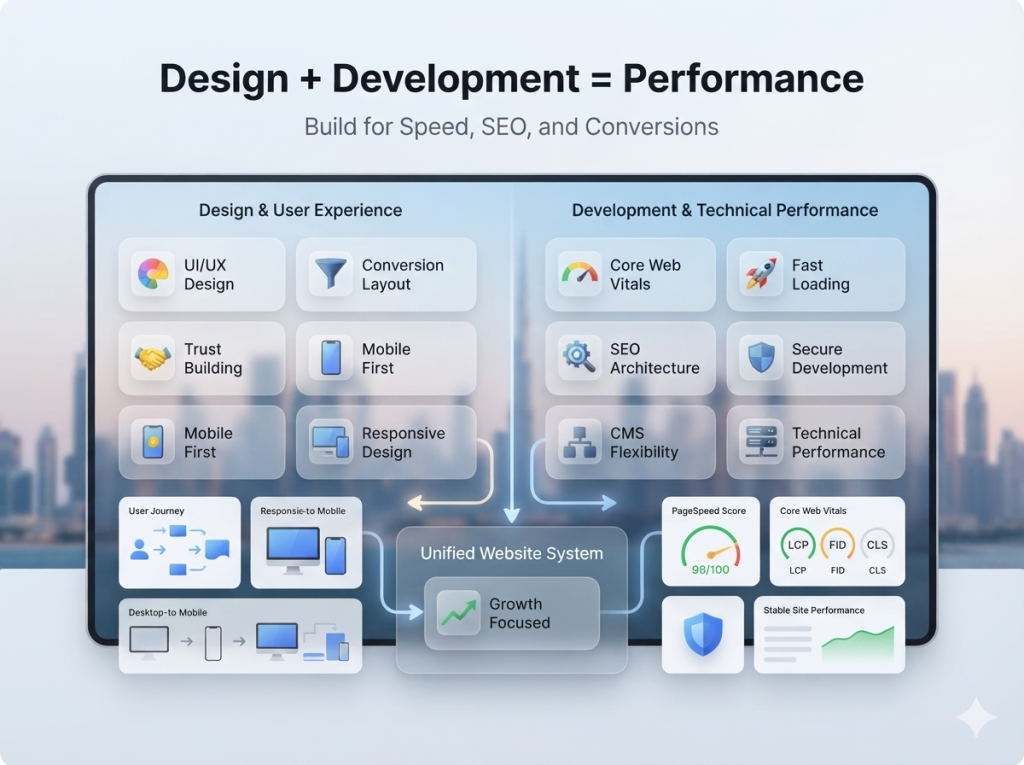
The problem is not a lack of creative talent. The real issue is that web design and web development are too often treated as separate services when they should work together as one system. The businesses succeeding online understand this. They invest in design that builds trust from the first visit and development that ensures the website loads quickly, ranks well, and performs reliably as traffic grows.
This guide explains what that approach looks like in practice, how website expectations in Dubai have evolved in 2026, and how to tell the difference between an agency that builds a genuine business asset and one that simply delivers an attractive digital brochure.
Why Dubai Businesses Can’t Treat Design and Development as an Afterthought
The UAE has one of the highest internet penetration rates in the world, and Dubai’s e-commerce and services sector keeps expanding across nearly every industry. That means your website isn’t competing against two or three local rivals anymore. It’s competing against every polished site a customer has seen that morning, whether that’s a real estate portal, an international SaaS product, or a competitor two buildings down who just relaunched.
With internet penetration in the UAE exceeding 99 percent and millions of active online shoppers, the demand for genuinely professional website development has never been higher. In a market this saturated, a website that merely exists isn’t enough. It has to actively work: load fast, build credibility within seconds, and guide the visitor toward a decision.
That’s the standard your web design and development partner needs to be building against, not “does it look modern.”
Design: What Actually Builds Trust With Dubai Audiences
Speed Is Part of the Design, Not a Technical Afterthought
A beautiful hero section means nothing if it takes four seconds to appear. More than half of mobile visitors abandon a site that takes longer than three seconds to load. In a city where people are browsing between meetings, in traffic, or on a cafe Wi-Fi connection near downtown, that three-second window is the real first impression, not the visuals that follow it.
Mobile Isn’t a Secondary View Anymore; It’s the Primary One
Dubai audiences browse on their phones constantly, whether that’s comparing service providers from a waiting room or scrolling a product page during a commute. Google also evaluates ranking primarily through the mobile version of a site. Designing desktop-first and shrinking it down for mobile later is exactly backwards from how the market actually behaves, and it shows in bounce rates.
Dark Mode and Adaptive Interfaces Are Now Expected, Not Optional
In dimly lit restaurants, during evening commutes, or poolside at night, users increasingly expect a dark mode option rather than treating it as a bonus feature. Beyond usability, a well-executed dark theme reads as premium and considered, which matters enormously for hospitality, real estate, and luxury service brands trying to signal sophistication before a single word is read.
Personalization Is Becoming the Norm, Not the Exception
Static homepages that show the same message to every visitor are losing ground to adaptive experiences that adjust content blocks, language, or featured services based on how someone arrived at the site. A returning enterprise client and a first-time visitor comparing three agencies shouldn’t necessarily see an identical homepage, and increasingly, in well-built 2026 sites, they don’t.
Development: The Part That Determines Whether the Design Actually Performs
Core Web Vitals Aren’t Optional Anymore
Google treats Core Web Vitals as a direct ranking factor, and sites that score poorly on loading speed, layout stability, and interaction responsiveness lose both visibility and visitors. A development team that isn’t actively optimizing for these metrics is building a site that will underperform in search results regardless of how good the design looks.
Modular, Headless Architecture Gives You Room to Grow
Rebuilding an entire website every time you need to add a service page or launch a campaign landing page is expensive and slow. A modular or headless CMS approach separates content from the visual layer, which means your team can update copy, launch new pages, or test layouts without waiting weeks for developer availability every single time.
Progressive Web App Capability Is Worth Serious Consideration
For businesses where repeat visits matter, whether that’s an e-commerce store or a service booking platform, progressive web app architecture delivers app-like speed and offline functionality without asking customers to download anything from an app store. Businesses adopting this approach are seeing measurably longer session times and stronger return visit rates.
Security and Data Compliance Are Built In, Not Bolted On
With the UAE’s Personal Data Protection Law now fully enforced, any site collecting customer information, whether through a contact form, checkout flow, or newsletter signup, needs SSL encryption, transparent data handling, and cookie consent that actually functions rather than a banner that ignores the user’s choice. This isn’t a legal afterthought anymore. It’s a baseline development requirement.
SEO Architecture Has to Be Part of the Build, Not a Separate Project
A site can look flawless and still be invisible on Google if the underlying code, heading structure, internal linking, and page speed weren’t planned with search visibility in mind from day one. The businesses winning organic traffic in Dubai’s competitive market are the ones where SEO strategy shaped the site structure before a single page was designed, not the ones bolting SEO fixes onto a finished build.
Choosing a Web Design and Development Partner in Dubai
With so many agencies competing for the same clients, the fastest way to separate serious partners from portfolio-driven studios is to ask about process, not just past projects.
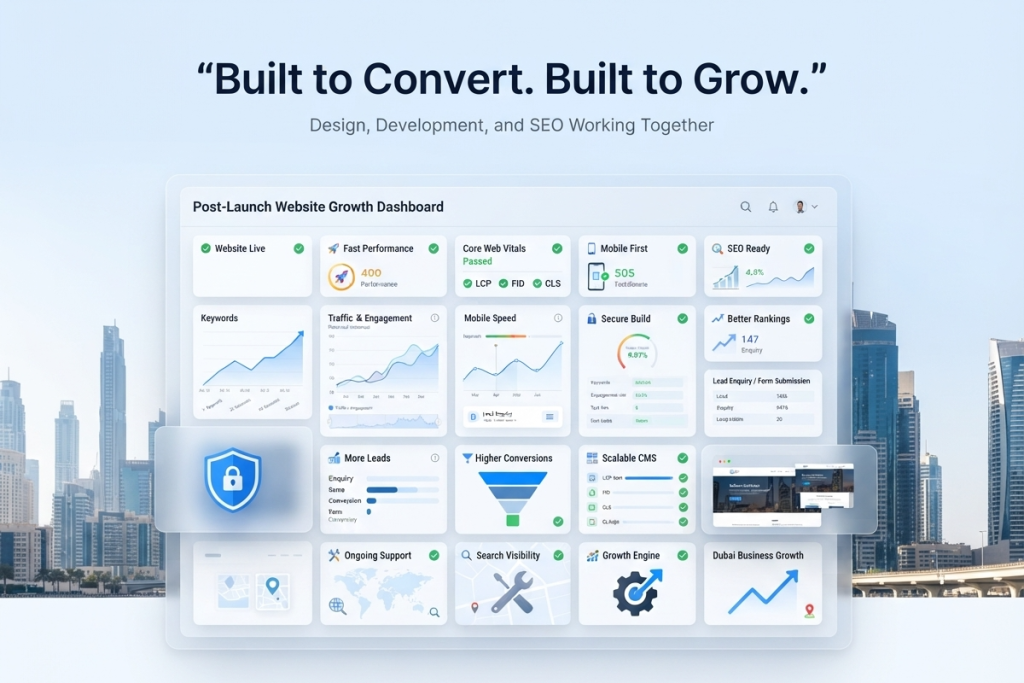
Ask how design and development teams collaborate. If they’re separate departments handing work back and forth with little coordination, expect friction and compromises later in the project.
Ask when SEO enters the process. If the honest answer is “after the site launches,” that’s a site built to look good in a pitch deck and struggle in search results.
Ask how they handle performance testing. Real page speed only becomes clear once actual images, fonts, and content are loaded, not with lightweight placeholder text during a demo.
Ask what happens after launch. A website is a living asset that needs ongoing updates, security patches, and content refreshes, not a one-time deliverable that gets forgotten the day it goes live.
If you want to see how a Dubai-based team approaches these questions in practice, our team breaks down real project decisions and technical strategy on the Newton Byte blog, covering everything from design systems to the development choices that keep a site fast and search-ready long after launch.
Frequently Asked Questions
Web design covers the visual and user experience side of a website: layout, colors, typography, and how content is arranged to guide a visitor toward an action. Web development is the technical build behind that design: the code, database structure, server logic, and performance engineering that make the design actually function in a browser. A strong website needs both working together from the start, not one department fixing what the other overlooked.
Pricing depends heavily on scope. A straightforward brochure site for a small business sits at a very different budget than a custom e-commerce platform or a web application with user accounts and payment integration. The most accurate way to budget is to get a scoped quote based on your specific page count, functionality, and whether ongoing SEO or content support is included.
A standard business website typically takes four to eight weeks from initial planning through launch, assuming content and branding assets are ready early in the process. Larger projects involving custom functionality, e-commerce, or multi-language support can extend to three to six months. Delays most often come from slow content delivery on the client side, not the build itself.
Templates work well for straightforward informational sites with limited functionality and a tight budget. Once your business needs custom features, specific integrations, or a design that clearly differentiates you from competitors using the same template library, custom development becomes the better long-term investment, since it avoids the platform limitations that eventually force a rebuild anyway.
Not automatically, and this is a common misconception. A new website only improves rankings when SEO architecture, page speed, and content strategy are built into the project from the beginning. A visually improved site with the same technical and content weaknesses as before will often see rankings stay flat or even dip temporarily during the transition.
For the overwhelming majority of businesses, yes. Dubai’s mobile browsing behavior is exceptionally high, and Google ranks sites primarily based on their mobile version. Even B2B or enterprise-focused businesses that assume their audience browses on desktop typically see a significant share of initial research and comparison happening on mobile devices first.
Look past visual polish alone and ask about results: page speed scores, ranking improvements, or conversion rate changes on past projects. A strong portfolio shows variety across industries and includes at least a few examples where the agency can speak specifically to the technical and SEO decisions behind the design, not just the finished screenshots.
Most businesses benefit from smaller, ongoing updates every six to twelve months, refreshing content, testing new conversion elements, and fixing performance issues as they appear, rather than waiting years for a full rebuild. A complete redesign typically makes sense every three to five years, or sooner if the underlying platform can no longer support the business’s growing needs.
| Ready to build a website that’s designed to perform, not just look impressive in a screenshot? Our team at Newton Byte plans design and development together from day one, with SEO and performance built into every decision. Reach out to scope your project and see exactly what a results-driven build looks like for your business. |